Tag: DataOps

  • Trends and Predictions for MLOps in 2023

    Trends and Predictions for MLOps in 2023

    In one of our articles, we have seen how MLOps is a set of practices to bridge data science, machine learning, data analytics, engineering, and development. This bridging feature of MLOps made it a highly emerging option to adopt between many organisations. Nowadays, we can see this as a helper to organisations, professionals, and advanced systems to continuously and consistently deploy data models. This technology combines some operating technology components, people and a set of practices. In simpler terms, MlOps leverages data, technology and people systems to empower production-level machine learning.

    While working on catering MLOps to many clients, we have observed that growing companies are using MLOPs to meet the evolving challenges in scaling machine learning. In this blog, we will look at some top MLOps trends and our predictions for 2023 in the field that is certain to become a leading aspect in the field.

    DataOps with MLOps

    This has been seen from the start that machine learning models are more reliable when the data we use to train them is appropriate. The term DataOps has been in use since around 2013 and has gained widespread recognition and adoption in recent years as organisations have become more data-driven and have faced increasing challenges in managing large amounts of data. This set of practices helps streamline the machine learning pipelines by fixing the quality of data coming to train and run machine learning models. Its impact has also been seen in advancing the growth of machine learning deployment.

    DSW’s solution platform UnifyAI is designed in such a way that it can give you growth in AI and ML development, including both MLOps and DataOps practices. To learn more about DataOps, you can refer to this article.

    Value Enhancement of AI/ML Solutions

    The main reason behind the adoption of AI and ML solutions is that they can increasingly make an impact on global industries, and those who are applying them in their functions can quantify and track the value. The greater the visibility of the impact, the higher the enhancement of the organisation’s health, security, and reputation. To improve the visibility of the impact of AI and ML, we can track the quality of the model and data and the reusability of the data. After that, quantification of the impact becomes easier.

    Here UnifyAI comes with its unique feature(observability), using which anyone can track the health of the applied model and data. Its advanced features increase observability and provide better monitoring. Enabled feature store gives you high data reusability using which you can go for CE/CD(continuous experiment and continuous deployment).

    Technical Component Management in MLOps Deployment

    MLOps is one of the trending topics in the field of data science and artificial intelligence that expands beyond the process of transforming AI and ML development. Participation of technology components to successfully implement MLOps is required, but managing those technologies better is more important. Only A good architecture can give the development of AI speed, accuracy, and scalability. It is crucial as well as tough to form a group of technology components from various sources and integrate together to follow best practices.

    UnifyAI encompasses all the critical technology components, and its development follows a cutting-edge architecture, allowing organizations to concentrate solely on AI and ML development without worrying about architectural design.

    MLOps will Enhance the Reliability of AI and ML

    There is no doubt in saying MLOps and machine learning are advancing the industry, and it has been mentioned in many reports that many sectors of industries will continue to adopt AI. As MLOps is not only changing the way of AI development but also ensuring that models that are working in production are more accurate and robust. This way, organisations are more focused on adopting the SOTA way of implementing MLOps. We can say that companies adopting MLOps will trigger increasing investment in machine learning.

    UnifyAI is developed to leverage MLOps and bring AI applications from the experimental phase to large-scale production with increased efficiency, making organizations more competitive in the industry.

    Integration of MLOps will Remain Challenging.

    Building AI and ML models are challenging, but streamlining and taking them into production is more challenging. Onboarding these models requires orchestrating workloads of technology components, balancing servers and giving them scalability in production. When we say making an organisation AI-enabled, is not just mean applying one or two AI applications in their processes, but it takes a load of AI models where some of the AI models are required to be trained and stored in repositories for further usage either in case of failure or in case of more accurate results and some of them to make it to the production with required scalability and robustness.

    UnifyAI facilitates smooth experimentation and deployment of AI and ML models for organizations. It features accessible interfaces for the rapid creation and storage of new models, as well as effective management of stored or running models. An orchestrator, acting as the central component of AI systems, provides a seamless experience for distributing models, data, and workloads throughout the processes.

    More Libraries and Packages for MLOps Tasks

    Since MLOps enhances the capability and adaptability of machine learning models regardless of cloud providers or technical stacks, getting a one-stop solution will remain challenging. The reason being the number of libraries and packages is increasing rapidly and making it difficult to choose and become dependent on one. Being adaptable all time is a difficult process and causes a decrease in the speed of development.

    In the development of UnifyAI, we have ensured that it can be easily integrated with new technologies, enabling users to adapt to changes and facilitating the acceleration of advancements.

    The usage of Feature Stores will Increase

    However, the technology is newer than the others, but it has become a mainstream component of MLOps. As it increases the reusability of the data features, enhances data collaboration between various teams, and allows faster experiments, it makes the MLOps more efficient.

    UnifyAI incorporates a feature store to offer the advantages of using a feature store in MLOps. The orchestrator within UnifyAI obtains data from the feature store and passes it to the models in production, streamlining the deployment process and reducing the likelihood of errors.

    Final words

    In this blog post, we’ve discussed our predictions for MLOps in 2023 and its growing importance across various industries. We have found through working with organisations in different sectors that the proper approach to AI development is crucial for delivering more significant impact and value. Without scalability, robustness, adaptability, and sustainability in AI development, organisations fail to bring AI into production. Our aim through these predictions is to make AI accessible to all and guide them in the right direction using UnifyAI.

    About DSW

    DSW, specializing in Artificial Intelligence and Data Science, provides platforms and solutions for leveraging data through AI and advanced analytics. With offices located in Mumbai, India, and Dublin, Ireland, the company serves a broad range of customers across the globe.

    Our mission is to democratize AI and Data Science, empowering customers with informed decision-making. Through fostering the AI ecosystem with data-driven, open-source technology solutions, we aim to benefit businesses, customers, and stakeholders and make AI available for everyone.

    Our flagship platform ‘UnifyAI’ aims to streamline the data engineering process, provide a unified pipeline, and integrate AI capabilities to support businesses in transitioning from experimentation to full-scale production, ultimately enhancing operational efficiency and driving growth.


  • Introduction to DataOps

    Introduction to DataOps

    In the current data analytics and data science scenarios, we can see the emergence of one new member named as DataOps. When we work around MLOps(machine learning operations), we definitely use practices defined inside DataOps, which is also a set of rules, practices and processes but aims to improve data communication, integration and automation. As data is the new fuel, any organization processing based on data needs a higher quality data processing to run it appropriately. Practices of DataOps can establish better data collaboration and improve the data flow speed and data quality across any organization. So Let’s take an introductory dive into the subject and understand it.

    What is DataOps?

    In simple words, we can define DataOps as a set of practices, processes, and technologies to efficiently design, implement and maintain data distribution architecture in any data workflow so that higher business values can be obtained from big data. Generally, the implementation of these practices includes a wide range of open-source tools to make the data accurately flow in the direction of production.

    We can also think of DataOps as DevOps of the data pipeline, where these practices strive to increase the speed of applications that work around big data frameworks. The main objective of opting DataOps should be leveraging data silos efficiently with the data management, IT operation and software teams. This ensures that data is being used in the most flexible, quickest and most effective manner to gain higher business values from the data.

    When going deeper into this topic, we find that this newer technology includes so many technology components in the data lifecycle to bridge many technology disciplines like data development, data quality management, data extraction and transformation, data governance and centre capacity control, and data access.

    One big difference between DevOps and DataOps is that almost zero software or tool helps in DataOps. So to build a complete DataOps process, the collaboration of tools like ETL tools, cataloguing tools, system monitors and data curation tools are required. With the help of the well-structured architecture of these tools, we can increase the agility of the system.

    Practices Behind DataOps

    Here are a few best practices associated behind the DataOps implementation strategy:

    1. Establishment of performance measures and benchmarks at every stage of the data lifecycle.
    2. Predefine the rules for data and metadata before applying them to any process.
    3. Use monitoring and feedback loops to maintain the quality of data.
    4. Use tools and technology to automate the process as much as possible.
    5. Usage of optimization processes for better dealing with bottlenecks such as data silos and constraint data warehouses.
    6. Ensure the scalability, growth and adaptability of the program before implementing it.
    7. Treat the process as lean manufacturing that focuses on constant improvements to efficiency.

    Benefits of DataOps

    As we discussed, DataOps is a set of practices aiming at the betterment of collaboration, improving the speed and quality of data flowing and processing across any organization. This set of practices includes the following seven main benefits for organizations:

    1. Collaboration: DataOps helps in improving the collaboration between the different teams like data engineers, data scientists, business stakeholders, and operations teams, which also helps to speed up the data flow with sustainable quality.
    2. Automation: data automation is one of the key benefits of DataOps as it helps avoid manual and repetitive data processes like data ingestion, cleaning, processing, and deployment.
    3. Continuous Integration and Continuous Deployment (CI/CD): It leverages a better CI/CD environment around data products, including data pipelines, machine learning models and many more, and enables rapid iteration and deployment.
    4. Monitoring and Feedback: this set of practices encourages the importance of monitoring and Feedback. It loops them to detect and resolve issues in real time, which leads to continuous improvement of data products.
    5. Data Quality: the main focus of DataOps is to improve the quality by using the practices such as data validation, profiling, and governance
    6. Data Security: DataOps helps easily take control over data encryption, data access control, and data masking so that data security can be ensured.
    7. Data Governance: DataOps includes practices that ensure data is managed nicely and used ethically. This part of the benefits can be achieved using processes like data stewardship, metadata management, and data lineage tracking.

    How DataOps Works

    As discussed above, DataOps is a set of practices that aim to streamline and strengthen the collaboration and communication of data processes and data flows. As a set of practices, it takes a team involving members of different roles and responsibilities, such as data engineers, data scientists, and business analysts in team works and follows this set of practices to work more efficiently and effectively. Making data pipeline integration and delivering continuity, making data validation easy, and real-time data monitoring are the primary motives of DataOps, while also increasing the quality of data and reducing errors.

    We can also think of Dataops similarly to lean manufacturing, focusing on minimizing the waste within manufacturing processes. In many places, we see the use of SPC(statistical process control) to constantly monitor and validate the data analytics consistency. The SPC is used to ensure that statistics remain within optimized ranges, higher data processing efficiency and improved data quality.

    Evolution from ETL to DataOps

    We all know that it all started by ingesting data on-premises into databases where self-built data connectors helped in ingestion, and because of being slow, ETL tools came into the picture.

    Being hardware, issues such as less scalability, transformation and continued deficiencies came with the data connectors.

    In the second phase, cloud data warehouses got introduced in the field and eliminated the classic hardware with scalability issues. Here ETL platforms started reducing the number of data connectors in the pipeline. With these developments, data ingestion becomes easy, but data transformation remains similar.

    Soon cloud data warehouses started providing facilities for data transformation inside them, and this is how the concert of data lakes came into the picture and offered unlimited insights from endlessly queryable data.

    Nowadays, we can see that companies are not facing the issue of data generation but delivering it appropriately is a constant one. Also, various traditional ETL platforms are still working, leading to data silos and distribution between authorized users.

    About DSW

    DSW, specializing in Artificial Intelligence and Data Science, provides platforms and solutions for leveraging data through AI and advanced analytics. With offices located in Mumbai, India, and Dublin, Ireland, the company serves a broad range of customers across the globe.

    Our mission is to democratize AI and Data Science, empowering customers with informed decision-making. Through fostering the AI ecosystem with data-driven, open-source technology solutions, we aim to benefit businesses, customers, and stakeholders and make AI available for everyone.

    Our flagship platform ‘UnifyAI’ aims to streamline the data engineering process, provide a unified pipeline, and integrate AI capabilities to support businesses in transitioning from experimentation to full-scale production, ultimately enhancing operational efficiency and driving growth.

  • Feature Stores & Their Role in MLOps

    Feature Stores & Their Role in MLOps

    The concept of a feature store in data science and artificial intelligence is relatively new but has its root in the field. In the early stages, features for AI models were typically hand engineered by data annotators and stored in various formats such as CSV, spreadsheet or databases. However, this way of storing data features found difficulties in data management, sharing and reusability.

    In the early 2010s, the field witnessed the rise of the big data concept and the increasing popularity of MLOps, which led to a need for specialised data storage systems for data features, and this is how feature stores found their way to fit in between the data and the ML models.

    What is a feature store?

    In one of our articles, we explored this topic. Still, in simple terms, a feature store is a technology we use to manage data more efficiently, particularly for machine learning models or machine learning operations.

    As we all know, MLOps is a way to compile or structure all technology pieces together in order to deploy, run, train and manage AI models. An MLOps system majorly consists of components of

    • Machine learning
    • DevOps (development operations)
    • Data Engineering

    Empowering a feature store in the MLOps can increase the craftsmanship of ML teams because the data flow can be more easily managed.

    How do feature stores work?

    Typically, data used to be stored somewhere on servers, and data scientists could access the data when going for data analysis, or server users could access it to display the data. But as big data came into the picture, such storage facilities and recalling became less feasible.

    In the real world, we can see that AI and ML fulfil different kinds of use cases which leads to the requirement of different datasets in different formats. Fulfilment of this need requires a lot of data transformation and a combination of different tables to generate a standard feature set to serve a model.

    These common data-related challenges that an AI project faces when putting ML models into production:

    • Access to the right raw data
    • Getting correct features from raw data.
    • Compiling feature into training data.
    • Managing features in the production

    Feature store helps in solving these problems and fulfilling the data demands made by the models and ML workflow. Using the feature store, data scientists become capable of:

    • Verify the validity of the data.
    • Check the quality.
    • Re-use the data.
    • Versioning and control of data.

    Nowadays, in MLOps, feature store has become a compulsory technology to fit between the data source and machine learning model because it accommodates the accessibility that a machine learning team seeks.

    Where data is the lifeblood of any ML or AI model, a feature store helps ML and AI teams to:

    • Collaborate efficiently
    • Reduce data duplication
    • Develop faster
    • Compliance with better regulations

    Features of a Feature Store

    Till now, we have majorly discussed the need for a feature store in MLOps, and when we talk about the features of any feature store then, these are the following feature a feature store should consist of.

    Capable of data consumption from multiple sources

    In real life, it has been observed that there are multiple data sources of companies, and from those sources, only a few data are usable for AI and ML models. In that case, a feature store should be capable of extracting and combining important data from multiple sources; this means the feature store should be able to be attached by many sources. A feature store can consume data from

    • Various streams
    • Data warehouses
    • Data files

    Data transformation

    One of the key benefits of applying a feature store in MLOps is that it helps data scientists easily get different types of features together to train and manage their ML models.

    As we know, data is being gathered from different sources in different formats, while s feature store fit in between models and data sources transforms data and joins the models in consistent ways and also enables data monitoring. For example

    Gathering data features from different sources is not the only task a feature store performs but also enables data teams to transform the data in the required form. One-hot encoding, data labelling and test data encoding are a few data transformation techniques which value only an ML engineer can understand.

    Here feature store verifies the consistency of data transformations while data analytics and monitoring ensure data is applicable for modelling.

    Search & discovery

    Feature store is one of the ways to encourage collaboration among DSA and ML teams. It simply enhances the reusability of data features because once a set of features is verified and works well with a model, the feature set becomes eligible to be shared and consumed for other modelling procedures that can be built for completing different purposes.

    A good feature store is always provided with a smart sharing setting that ensures the important features are standardised, and reusability is increased.

    Feature Serving

    Features stores should not only be capable of extracting and transforming data from multiple sources, but also they should also be able to pass data to multiple models. Generally, different APIs are used to serve features to the models.

    Since models need consistency in features served to them, so in serving a check is important to verify the data fits the requirements of the models.

    Monitoring

    Finally, one of the most important features that should be applied to any block of code is accessibility to monitoring. A feature store should be provided with appropriate metrics on the data, which can discover the correctness, completeness and quality of the data that is passing through the feature store.

    The aim of monitoring is to become updated, debugged and advanced about the system.

    Conclusion

    If you go through this article, then you will get to know that The MLOps is a set of many blocks and steps that need to work Parelally when a machine learning or AI model is going to be deployed into production. Serving data in these steps or blocks in one of the first steps of the whole procedure can define the reliability and accuracy of the whole procedure. So feature store becomes a requirement when you follow the practises defined under MLOps and require efficient results from it.

    To give you a valuable experience of MLOps for real-life AI use cases, DSW | Data Science Wizards has come up with a state-of-the-art platform UnifyAI. This platform not only allows you to deploy AI and ML models into production seamlessly but also engages fewer technology components in your MLOps journey to avoid the complex engineering and get more focused on experimenting across all the models to get value-making data and AI-driven decisions.

    The provided feature store with UnifyAI has all the key features that one optimised feature store should have and using this feature store, you can enhance the consistency, quality, serviceability and reusability of important features and can get high-quality results from your AI use cases.

    About DSW

    Data Science Wizards (DSW) aim to democratise the power of AI and Data Science to empower customers with insight discovery and informed decision-making.

    We work towards nurturing the AI ecosystem with data-driven, open-source technologies and AI solutions and platforms to benefit businesses, customers, communities, and stakeholders.

    Through our industry-agnostic flagship platform, UnifyAI, we are working towards creating a holistic approach to data engineering and AI to enable companies to accelerate growth, enhance operational efficiency and help their business leverage AI capabilities end-to-end.

    Our niche expertise and positioning at the confluence of AI, data science, and open-source technologies help us to empower customers with seamless and informed decision-making capabilities.

    DSW’s key purpose is to empower enterprises and communities with ease of using AI, making AI accessible for everyone to solve problems through data insights.

    Connect us at contact@datasciencewizards.ai and visit us at darkseagreen-chicken-141904.hostingersite.com/

  • Challenges Faced by Companies in the Adoption of AI

    Challenges Faced by Companies in the Adoption of AI

    Nowadays, it is not surprising to see companies using AI to get huge benefits. Even a 2022 report from Mckinsey states that AI adoption globally is 2.5x higher than in 2017.

    This data represents how the future of businesses is going to change due to AI adoption. Similarly, a Mckinsey 2020’s report signalling that revenue production by AI adoption will be doubled between 2020 and 2024.

    While looking at the competition behind AI adoption, a well architect AI implementation can be a game-changing event for any organisation and make them stand out from the competitors. However, a well architect AI implementation is challenging to get, and we at DSW | Data Science Wizards focused on creating AI-enabled ecosystems in different organisations through our tech-agnostic platform UnifyAI, so in this article, we are going to look at the challenges that any organisation can face during the journey of AI adoption and how UnifyAI can help organisations to help simply face and overcome those challenges.

    Let’s dive in.

    Challenges in AI Adoption

    Suppose you are considering using AI to complete any of your operations or looking for a scalable way to implement AI in your organisation. In that case, it is important to become aware of the challenges you might need to cope with and how UnifyAI, as a holistic approach, can resolve them. That way, you can successfully get a seamless path to AI adoption.

    Here are the most common challenges you will meet in making AI work for you.

    Organisations don’t understand the need for AI projects

    If an organisation is doing good business, then its team often becomes reluctant to adapt to noticeable changes and the adoption of technologies like artificial intelligence can be a challenging shift or task to perform.

    With this challenge convincing investors to invest in AI is also a challenge if the returns are unclear because where AI adoption is concerned, you will only sometimes be clear about what you are trying to build. Such uncertainty always becomes so much tricky to manage.

    In that case, you need not worry about the uncertainties involved in AI adoption because, as an AI consultant DSW has phenomenal expertise in helping organisations become AI-enabled. So we understand the potential benefits of implementing AI ecosystems, projects and use cases. Using our this expertise, organisations can understand the value of their data and the involvement of AI with it.

    Company’s data is not appropriate

    To get an effective AI agent, it is suggested to model it using a sufficient amount of well-optimized data. Simply, high-quality data can give a high-quality AI model. Unfortunately, sometimes older or inadequate data management systems cause difficulties in AI adoption.

    For example, suppose in any organisation, any CRM tool is being utilised for collecting demographic data, purchase behaviour and interaction data of customers. In that case, the organisation may have data that can be used for intelligent modelling. But if the data management is not optimised, that can mean the organisation is not interested in AI adoption. With the wrong data management system, making a structured way becomes difficult.

    These insufficient data management systems lead to confusing data lakes and silos, and considering this fact, we have designed our platform in such a way that it can easily gather and structure only important data from complex data systems and involve that data in the process of making data as a value for you.

    Organisations lack the skill-set

    Being equipped with high-quality data is not only a requirement to become AI-enabled but also needs the right skill sets, directions and components to make AI use cases work.

    In the competition of AI adoption, often organisation struggle to get the right data and AI skill set that leaves them unable to become AI-enabled. Even where companies have a high degree of in-house expertise, a lack of structuring AI components can become a significant obstacle in AI adoption.

    Using UnifyAI, you can eliminate many common problems like Insufficient processing, multiple data and model pipeline, and inefficient orchestration. It works as a solution for organisations that needs more major skill sets to complete MLOps.

    Organisations struggle to find good vendors to work with

    Somehow organisations understand that AI adoption is a way to perform better than before, and they believe that they don’t understand how to use their data and technology together to deliver higher business value.

    As a result, companies try to get AI adoption done with vendors, and negative experience with vendors makes companies reluctant to dive into AI adoption. However, with experienced AI vendors results of the work can speak for themselves.

    DSW has developed itself as a user of the finest state-of-the-art technologies to fulfil customers’ demand for higher business values using their data. We have constantly been developing cutting-edge solutions that can provide a seamless experience of creating AI environments throughout organisations. As a result, UnifyAI has come in front of us, which not only makes AI adoption easy but also allows us to scale newer or older AI use cases and projects.

    Organisations are not able to find a good use case

    Implementing AI just for the sake of it often doesn’t encourage company-wide adoption. When any organisation doesn’t have a strong AI use case, it will always be challenging to deliver high business value. Without a strong reason behind AI adoption, it only makes a difference towards a technological perspective. So it is a best practice to apply AI only when you know how it will be a serious advancement.

    However, there are more often chances that a company’s data has the potential to grab high business values, but somehow they need help understanding it. Our expertise in the field comes as a solution for such an organisation that helps organisations understand the value of their data and gain benefits using AI.

    Low explainability of AI Team

    Often, it has been observed that the data and AI teams end up working with data silos, meaning that most AI projects are stuck and die in dealing with vast amounts of data. Even after experimentation, they face considerable problems in production.

    As a result, they plan architectures of AI workflow, which only increases the complexity of making scalable AI projects, and the benefits from such projects need to be explained better to get the workforce for implementation.

    An AI team can avoid this complexity by using platforms such as UnifyAI that give them a seamless experience of taking AI use cases into production with high efficiency and explainability.

    Fear of overhaul legacy systems

    Nowadays, it is astonishing to see any organisation still rely on its old infrastructure to make its IT operation work. In such an organisation, management chooses not to adopt technologies like AI because of fear of the costs behind adoption.

    If the cost is a concern, then thinking of AI adoption as a costly program is a myth because there are open-source technologies that make AI adoption simple and cheap. However, doing so might need an operational framework on the premises.

    UnifyAI empowers organisations with an efficient operational framework in which all cutting-edge technologies are optimised and structured to give an easy and throughout experience from experiment to production to any organisation.

    One sure thing is that there are huge benefits from AI adoption.

    The complexity of AI Program Integration

    In most cases, it has been seen that an AI team has made an optimised program that can potentially give huge benefits. Still, the integration of these programs needs a huge amount of engineering, and this engineering becomes an obstacle for companies.

    More engineering effort for integration meant the solution never saw the light of day. This all happens because lack of skill sets for taking AI use cases from experimentation to production.

    One of the most critical features of UnifyAI is that it is engineered to deliver all simple or complex AI projects into production without requiring a high level of model engineering. This feature not only avoids the significant complexities in taking AI into production but also gives an environment using which one can scale AI.

    AI Governance

    In one of our articles, we learned about AI/ML model governance, and many AI projects face problems of implementation in real life. For example, to operationalise a cloud-based banking platform in Poland, the organisation needs to build data centres only in Poland.

    Often to build an AI use case, organisations need a massive amount of data, whether the data is sensitive or not, but it needs to keep in an adequately secure environment. In the failure of that organisation could face a considerable fine.

    Such rules and regulations become obstacles to AI adoption because governing bodies often halt solutions in their track. Therefore, as we keep track of such an important step behind A implementation, we also help organisations to understand and get work done while following every piece of information, rules and regulations.

    No challenges are greater than the results

    Although there are many challenges in AI adoption, organisations should be confident in the way of AI adoption. It has always been said that becoming aware of the pitfalls is an essential first step.

    After knowing all the obstacles an organisation might face, it can become more focused on finding strategic designs that can increase its chances of success. Looking at the potential benefits of AI adoption, there is no challenge that is too great to overcome.

    About DSW

    Data Science Wizards (DSW) aim to democratise the power of AI and Data Science to empower customers with insight discovery and informed decision-making.

    We works towards nurturing the AI ecosystem with data-driven, open-source technologies and AI solutions and platforms to benefit businesses, customers, communities, and stakeholders.

    Through our industry-agnostic flagship platform, UnifyAI, we are working towards creating a holistic approach to data engineering and AI to enable companies to accelerate growth, enhance operational efficiency and help their business leverage AI capabilities end-to-end.

    Our niche expertise and positioning at the confluence of AI, data science, and open-source technologies help us to empower customers with seamless and informed decision-making capabilities.

    DSW’s key purpose is to empower enterprises and communities with ease of using AI, making AI accessible for everyone to solve problems through data insights.

    Connect us at contact@datasciencewizards.ai and visit us at darkseagreen-chicken-141904.hostingersite.com/

  • End-to-End Random Forest Modelling

    End-to-End Random Forest Modelling

    In one of our articles, we discussed the basics of random forests, where we have seen how they work by ensembling various trees, what are its important features, hyperparameters, and their pros and cons. This article will show how a random forest algorithm will work with a real-life dataset. With the completion of this article, we will be discussing the following subtopics:

    Table of Contents

    • The Dataset
    • Exploratory Data Analysis
    • Data processing
    • Data Modelling
    • Model Evaluation
    • To Do List

    Let’s start with understanding the data.

    The Dataset

    To look deep into the subject, we choose to work with the health insurance cross-cell prediction data, which we can find here. Under the data, we get major information about the vehicle insurance acceptance record of more than 3.5 lakh customers. In against this acceptance, we get the demographic(gender, age, region, vehicle age, annual premium, etc.) information of the customers.

    Using this dataset, our task is to make a model that can tell us which customers will be interested in buying vehicle insurance based on similar demographic information. We have information about demographics (gender, age, region code type), Vehicles (Vehicle Age, Damage), and Policy (Premium, sourcing channel). Let’s check the data head.

    import pandas as pd

    import numpy as np

    train_data = pd.read_csv(‘/content/drive/MyDrive/articles/12–2022/17–12–2022 to 24–12–2022/train.csv’)

    train_data.head()

    Output:

    Here we can see the values we have provided to train a random forest model. In the above Response variable is our target variable where 1 : Customer is interested, 0 : Customer is not interested. Now, let’s move towards the first step of this modelling procedure, which is exploratory data analysis.

    Exploratory Data Analysis

    This step will let us know about the insights of vehicle insurance data so lets start with knowing the infomarmation which this data consists.

    train_data.info()

    Output:

    By looking at the above output, we can say that this data has 9 categorical values, and with this, we can start plotting these values into graphs so that we can get more information out of this data.

    Let’s begin with our target variable.

    By looking at the above output, we can say that this data has 9 categorical values, and with this, we can start plotting these values into graphs so that we can get more information out of this data.

    Let’s begin with our target variable.

    Response valuable

    train_data[‘Response’].value_counts().plot(kind = ‘bar’)

    Output:

    Here we can see that we had a huge customer response of 0, which means the majority of customers are not interested in buying vehicle insurance. Now it’s our target to understand how this response variable is dependent on other information given in the data.

    Response with Gender

    train_data[[‘Gender’, ‘Response’]].value_counts().plot(kind = ‘bar’, stacked = True, )


    Looking at this chart, the responses from men are more than women, which is also similar to the positive response.

    Response with Age

    train_data[‘Age’].describe()

    Here we can see that in the Age column, we have the minimum age of any customer is 20, and the highest age is 85 years. So better visualisation In this section, we are going to separate the age values by the range of 10, and we will be able to see how different age ranges of customers are responding.

    bins = np.arange(1, 10) * 10

    train_data[‘category’] = np.digitize(train_data.Age, bins, right=True)

    counts = train_data.groupby([‘category’,’Response’]).Age.count().unstack()

    print(counts)

    counts.plot(kind=’bar’, stacked=True)

    Here we can see that most of the records in the data are for the customer age range of 30–40 years, but proportion-wise, customers over 40 years old are more interested in buying vehicle insurance.

    Response with driving license

    train_data[[‘Driving_License’,’Response’]].value_counts().plot(kind = ‘bar’)

    Output:

    Here we can see that there are few records of customers with no driving license, and they also responded as no, which is fair enough.

    Response with Region

    counts = train_data.groupby([‘Region_Code’,’Response’]).Gender.count().unstack()

    counts.plot(kind=’bar’, stacked=True, figsize=(35, 10

    Output

    Here we can see the distribution of responses from customers according to the region, and by zooming in, we can see that region 28 holds the most number of records.

    Previously Insured and Response

    counts = train_data.groupby([‘Previously_Insured’,’Response’]).Gender.count().unstack()

    print(counts)

    counts.plot(kind=’bar’, stacked=True)

    Output:

    Here we can see that most of the positive responses were from customers who had not previously received their vehicle insurance.

    Reponse with Vehicle Age

    With this variable, we can extract information about the most positive responses with respect to vehicle age.

    counts = train_data.groupby([‘Vehicle_Age’,’Response’]).Gender.count().unstack()

    print(counts)

    counts.plot(kind=’bar’, stacked=True)

    With this output, we can assume that the top part of the data is covered by vehicles aged 0 to 2 years, and mostly positive responses are from the customers who have vehicles aged 1 to 2 years.

    Response with Vehicle Damage

    Here we take a look at how customers choose to buy insurance when their vehicle is damaged.

    counts = train_data.groupby([‘Vehicle_Damage’,’Response’]).Gender.count().unstack()

    print(counts)

    counts.plot(kind=’bar’, stacked=True)

    Output

    Here we can see that most customers are ready to buy insurance for their vehicle when it is already damaged.

    Annual Premium

    Since this is a continuous value, we can draw a density plot of the annual premium and see its description to know its minimum, maximum and average value.

    train_data[‘Annual_Premium’].describe()

    train_data[‘Annual_Premium’].plot(kind = ‘kde’)


    +6

    Here we can see that the minimum size of the annual premium is 2630, and the maximum is 540165, while the average value is around 30564.

    Vintage

    This column represents the count of days of a customer associated with the organisation.

    train_data[‘Vintage’].describe()

    train_data[‘Vintage’].plot(kind = ‘kde’)

    Output

    Here we can see that the minimum count of customer association days is 10 days, and the maximum is 299, while the average count is 154 days. So this means most of the customers have been associated with customers for the last 154 days.

    Now that we have completed a basic exploratory data analysis, we will prepare it for the data modelling procedure.

    Data processing

    For modelling the data, we are going to use the scikit learn library that only works with the numerical values, and as we know, we have many string values in the data, so we will need to convert them into numerical data by label encoding we can do.

    Label encoding

    By looking at the data, we know that we have three variables that have categorical values in the form of the string value, so let’s convert these values.

    train_data[‘Gender’]=train_data[‘Gender’].replace({‘Male’:1,’Female’:0})

    train_data[‘Vehicle_Age’]=train_data[‘Vehicle_Age’].replace({‘< 1 Year’:0,’1–2 Year’:1, ‘> 2 Years’:2})

    train_data[‘Vehicle_Damage’]=train_data[‘Vehicle_Damage’].replace({‘Yes’:1,’No’:0})

    train_data.head()

    Output:

    Here we can see that all the values are in the numerical format while we have changed binary string values in the form of 0 and 1 binary integer values, and for the vehicle age variable, we have given 0, 1 and 2 as numerical categorical data points.

    Now we would need to split this data into train and test sets so that we can evaluate the fitted model properly.

    Data splitting

    from sklearn.model_selection import train_test_split

    X = train_data.iloc[:, 0:-1]

    y = train_data.iloc[:, -1]

    X_train, X_test, y_train, y_test = train_test_split(X,y, test_size = 0.25, random_state = 4)

    Here we split the data in 75:25 so that we can train a model using 75% of the data and evaluate it with 25% data. Next, let’s move towards the data modelling procedure.

    Data Modelling

    Using the below line of code, we can train a random forest model using our processed data.

    from sklearn.ensemble import RandomForestClassifier

    model = RandomForestClassifier()

    model.fit(X_train,y_train)

    Let’s make predictions from the model and plot it once to see whether the model is working well or not.

    y_pred = model.predict(X_test)

    y_prediction = pd.DataFrame(y_pred, columns = [‘predictions’])

    y_prediction[‘predictions’].value_counts().plot(kind = ‘bar’)

    Ouput:

    Here we can see that model is making predictions for both categories. So now, let’s evaluate the model.

    Model Evaluation

    In the above, we have done the data modelling using the random forest algorithm. Now, we are required to perform a model evaluation to tell about our model’s reliability and performance. Using the below lines of codes, we can measure the performance of our model

    from sklearn.metrics import mean_absolute_error,mean_squared_error,confusion_matrix,r2_score,accuracy_score,classification_report

    print(“Classification Report:n”,classification_report(y_test,y_pred

    print(“Confusion Matrix:n”,confusion_matrix(y_test,y_pred

    print(“Training Score:n”,model.score(X_test,y_test)*100)

    print(“Mean Squared Error:n”,mean_squared_error(y_test,y_pred

    print(“R2 score is:n”,r2_score(y_test,y_pred

    print(‘model parameters n’,model.get_params(

    print(‘model accuracy n’,accuracy_score(y_test,y_pred)*100)

    Ouput:

    Here we get most of the metrics in the final report that can be used for model evaluation, and looking at the report, we can say that our model is performing well with such huge data. However, we can make many improvements to the model, which we will discuss later in the article.

    To learn about the evaluation metrics, we can go through this article, where we explain every critical metric we use in real life to evaluate such models.

    To-Do List

    In this procedure, we have performed every basic step which a data modelling procedure needs to go through, and below are the advanced steps we will perform to improve the results of this procedure:

    • More EDA: as we can see in this article, we used only pandas for data visualisation, so in the next article, we will be using more visualisation libraries to perform EDA more properly.
    • SMOTE analysis: in the data visualisation part, we can see that records for a positive response were too low, which can lead to biased modelling, so in the next article, we will see if we can improve the performance using SMOTE analysis.
    • Cross Validation: We know that we got good enough results from the last modelling, and to improve the score, we can also use the cross-validation method so that model can become more reliable.
    • GridSearchCV: it is a method used for finding the optimal model when the model has too many parameters, and Random Forest is one of those models that can be modified by changing parameters.

    References

    About DSW

    Data Science Wizards(DSW ) aim to democratize the power of AI and Data Science to empower customers with insight discovery and informed decision making.

    We working towards nurturing the AI ecosystem with data-driven, open-source technologies and AI solutions and platform to benefit businesses, customers, communities, and stakeholders.

    Through our industry-agnostic flagship platform, UnifyAI, we are working towards creating a holistic approach to data engineering and AI to enable companies to accelerate growth, enhance operational efficiency and help their business leveraging AI capabilities end-to-end.

    Our niche expertise and positioning at the confluence of AI, data science, and open-source technologies helps us to empower customers with seamless and informed decision-making capabilities.

    DSW’s key purpose is to empower enterprises and communities with ease of using AI, making AI accessible for everyone to solve problems through data insights.

    Connect us at contact@datasciencewizards.ai and visit us at www.datasciencewizards.ai

  • What is AI/ML model governance?

    What is AI/ML model governance?

    As every small, medium and large organisation are willing to become data-driven, the application of machine learning and artificial intelligence is increasing rapidly. Also, when we look at the market, we find that AI and ML market is one of the prominent and challenging markets nowadays. However, with these high values, this area also shows us a new source of risk. There can be various reasons, like an inadequately trained data model can lead to bad data-driven decisions, breaking the laws and many more.

    So it becomes a compulsion to define governance in AI/ML development to minimise the risk and improve the development quality. So Let’s look at the broader picture of AI/ML model governance.

    What is model governance?

    When an organisation starts controlling the model development process, usage, and validation or assigns the model’s restrictions, responsibilities and roles, this process can be considered model governance.

    We can compare model governance as a framework where this framework includes a set of strategies that help decide or specify how an organisation manages models within it. These strategies can be of the following type:

    • Strategies to control models in production
    • Strategies for versioning the models.
    • Documentation reaction strategies.
    • Model post-production monitoring
    • Models comply with existing IT policies.

    If any organisation can implement such a framework effectively, then they can get a high level of controllability and visibility into the model’s behaviour in production. At the same time, they get access to operational efficiencies and this help in achieving more benefits from AI investments.

    Increased visibility also allows you to easily identify and resolve the problems and risks of ML and AI, such as models being biased. It also makes us increase the performance of the model in production because enhanced visibility allows you to spot issues that degrade models performance over time, such as data decay, model drift etc.

    Importance of AI/ML Model Governance

    We know that artificial intelligence and machine learning are relatively new areas, and many inefficiencies must be resolved. Model governance not only helps solve many of these problems but also improves every aspect of development and the potential value of any AI project.

    We have already discussed that model governance helps in risk assessment, which is a major importance of AI governance as it ensures that the model stays out of risk with us. Many models are programmed to learn continuously after running them, and they can be biased because of biased data, which affects the decision-making of the model.

    A set of rules in the governance framework allows us to audit and test for the model’s speed, accuracy and drift while in production to prevent further difficulties. Since various clauses can be applied to Ai governance, we can easily find out the ownership and accessibility of the model.

    Such a governance framework can answer the following important questions:

    • Who is the model’s owner?
    • Do relevant rules and regulations restrict a model?
    • Data on which model is trained?
    • What sets of rules and regulations need to comply between the development stages?
    • What are the steps required to monitor models after post-production?

    Who is the model’s owner?

    In an organisation, we can find that various people are arranged to complete various work of any project. So it becomes an important task to keep track of the work of every person involved in the project. This tracking helps improve collaboration, lesser duplication, quality improvement, and improve problem-solving. It always becomes necessary to keep this in the rule book so that well-catalogued inventory can allow people to build on the work together more easily.

    Do relevant rules and regulations restrict a model?

    Often models require following the local or domain rules and laws, such as a recommendation system developed to find relationships between different goods in a supermarket and representing a strong relationship between cigarettes and chewing gum. Most countries don’t allow to advertising of cigarettes, so this kind of business recommendation needs to be dropped. So before deploying a model into production, we should consider the following things:

    • What local government defines regulations and laws relevant to any model’s functionality?
    • What are the ways to test the model’s functionality are complying with defined laws?
    • After making it into production, what will be the ways to monitor the model?

    Data on which model is trained?

    One very important thing about the machine learning model is that their results are indivisibly attached to the training data. So if there is any problem occurs in the development line, it becomes important to find the precise bad data points to replicate the issue. This is an ability in machine learning, and planning based on tracing the issues is crucial to avoid bigger failures.

    Keeping track of the data source is a worthy task because this helps in measuring model drift frequency and stability of the models on old data. So it is always suggested to train the model on a high data range to get different results, but for stability, we should consider a low data range.

    What sets of rules and regulations need to comply between the development stages?

    There are various model development stages involved in the process, and one should have approval at every stage and keep records to ensure a high-quality standard. And it also reduces the chances of failure making their way through the production. This set of rules can tell us about the following things:

    • Data quality
    • Feature engineering
    • Train/Test/Validation or cross-validation
    • Compliance testing
    • Code quality
    • Version control
    • Documentation

    It is highly suggested to get the development thoroughly checked by a qualified team or person outside the development team.

    What are the steps required to monitor models after post-production?

    One of the most important things about model governance is that it gets complete after we become capable of regularly monitoring our deployed model’s performance using various aspects like model drift, data decay and failure in the development pipeline.

    However, these aspects are internally connected, but they all represent their story differently. When things come into the post-production stages, it becomes necessary to maintain the system we have created and the new updates we are trying to give in the system. Early capturing of the likelihood of failure makes the system more accurate and reliable.

    Final words

    In the recent scenario, we have seen that every organisation are willing to become data-driven, or some are already data-driven, where machine learning models are helping them to complete various tasks. To maintain their high performance, effectiveness and quality, it is necessary to care about the model governance, which can lead your model to great success.

    Data Science Wizards (DSW) is an Artificial Intelligence and Data Science start-up that primarily offers platforms, solutions, and services for making use of data as a strategy through AI and data analytics solutions and consulting services to help enterprises in data-driven decisions.

    DSW’s flagship platform UnifyAI is an end-to-end AI-enabled platform for enterprise customers to build, deploy, manage, and publish their AI models. UnifyAI helps you to build your business use case by leveraging AI capabilities and improving analytics outcomes.

    Connect us at contact@datasciencewizards.ai and visit us at www.datasciencewizards.ai

  • How Artificial Intelligence is Advancing the EdTech Industries?

    How Artificial Intelligence is Advancing the EdTech Industries?

    In current scenarios, we all have seen the growth of the EdTech industries. Even after Covid-19, we can say that the growth is doubled. There are many reasons behind this growth; one of them is artificial intelligence has found many gaps to fill. However, the impact of AI is huge across industries. According to Statista, the AI market is expected to reach USD 126 billion by the end of 2025.

    A market and Markets report says that AI in EdTech is expected to grow to 3.68 billion USD by the end of 2023. These statics are sufficient to show EdTech’s reliability on AI. Especially, AI has found various use cases in online education systems. AI enables the industry right from delivering content to assessments and enhancing the learning experience. Here are the top applications of AI using which AI is helping EdTech to get more advanced.

    Customise learning journeys

    We find various unique values regarding learners’ interest and motivation to learn a subject. When we look back at the traditional approach to educational systems, they have been standardised for a long time because it was challenging to make them personalised for individuals. Nowadays, AI approaches have made it easy to create custom-tailored courses of learning based on learners’ behaviour observation and interpretation.

    AI systems can find out the learning gaps based on the performances of learners, as well as these can also find them based on their behaviour in a classroom. As we all know, personalisation has been the KPI of many businesses here, and it plays a significant role in collecting huge audience engagement and focus.

    Because of personalisation, learners get enabled to set up the pace of learning and ensure that they are on the right track of their learning journey.

    Automated Assessments

    Nowadays, we can see the impact of AI on grading because its use can be seen in both quantitative tests (multi-choice questions) and qualitative assessments (essay-based tests). This use of AI saves teachers time on grading and eliminates the chances of divergences based on favouritism and any other kind of corruption.

    In addition, we also get facilitated with understanding the impact and effectiveness of learning programs based on group levels. This analysis can make us stand out from the ground if changes in the curriculum become in the appropriate direction.

    AI Teaching Assistants

    One of the most excellent applications of AI is adaptive chatbots, which can be utilised here as a teacher’s assistant in online programs. Just assume that there is a chatbot that can interact with the learners and clarify many basic doubts. At the same time, they are capable enough to create multiple real-time stages to let learners evaluate their understanding.

    However, human teachers are a great way to teach anything, but they come with a working bandwidth and are incapable of always being available. This causes a gap and also an opportunity for AI to make a bridge. They can be available all the time and give freedom to learners using which they can approach them any time and get clarity.

    Simplifying Non-Teaching tasks

    Here, AI is not only to help the teachers and learners but also comes with many different use cases that are not core to teaching but are very helpful to run institutes easily. For example, using AI, we can easily handle records of students such as attendance, personal information etc., and teachers can be more focused on their teaching work. AI has also shown its capability in enrolment and admission processes so that more forces can get free.

    Final Words

    By looking at the above use cases, we can say the day is not so far where educators will need to rethink the learning journey and impact more students by giving extraordinary learning experiences, retention and focus. Furthermore, with the power of AI systems and tools, the EdTech industries can redefine the future and culture of education, where teachers and learners will be more focused on their actual work instead of being diverted because of too many other constraints or work.

    About DSW

    Data Science Wizards (DSW) is an Artificial Intelligence and Data Science start-up that primarily offers platforms, solutions, and services for making use of data as a strategy through AI and data analytics solutions and consulting services to help enterprises in data-driven decisions.

    DSW’s flagship platform UnifyAI is an end-to-end AI-enabled platform for enterprise customers to build, deploy, manage, and publish their AI models. UnifyAI helps you to build your business use case by leveraging AI capabilities and improving analytics outcomes.

    Connect us at contact@datasciencewizards.ai and visit us at www.datasciencewizards.ai

  • Getting Started with Machine Learning Algorithms: Random Forest

    Getting Started with Machine Learning Algorithms: Random Forest

    In supervised machine learning, there is a plethora of machine learning models like linear regression, logistic regression, decision tree and others. we use these models to resolve classification or regression problems, and ensemble learning is a part of supervised learning that gives us models that are built using several base models. Random forest is one of those ensemble learning models that are popular in the data science field for its high performance.

    Technically, random forest models are built on top of decision trees and we have already covered the basics of a decision tree in one of our articles, so we recommend reading the article once to understand this article’s topic clearly. In this article, we will talk about random forests using the following points.

    Table of content

    • What is Random Forest?
    • How Does a Random Forest Work?
    • Important Features
    • Important Hyperparameters
    • Code Example
    • Pros and Cons of Random Forest

    What is Random Forest?

    Random forest is a supervised machine-learning algorithm that comes under the ensemble learning technique. In supervised machine learning, a random forest can be used to resolve both classification and regression problems.

    As discussed above that, it comes under the ensemble learning technique, so it works on top of many decision trees. We can say that decision trees are the base model of a random forest. The algorithm simply builds many decision trees on different data samples, and using the majority vote system solves the classification problem. In the case of regression, it uses the average of the decision trees.

    How does a Random Forest Work?

    When we talk about the working of the random forest, we can say that it gives outcomes by ensembling the results of many decision trees. Here if we talk about a classification problem, each decision tree predicts an outcome and whatever the class gets majority votes comes out as the final result of a random forest. Let’s take a look at the below image.

    When we talk about the working of the random forest, we can say that it gives outcomes by ensembling the results of many decision trees. Here if we talk about a classification problem, each decision tree predicts an outcome and whatever the class gets majority votes comes out as the final result of a random forest. Let’s take a look at the below image.

    The above image also gives the intuition behind the ensemble learning technique, where the final prediction is made by combining the results of several other models. The ensemble learning technique can be followed using two ways:

    1. Bagging: this way, we divide data into various subsets and train the base models like decision trees in a random forest, and the majority vote for any class comes out as the final result.
    2. Boosting: this way, we combine weak learners with strong learners and make a sequence of the model so that the final model is most accurate amongst every learner. For example, XG boost and ADA Boost models.

    Random forest in ensemble learning uses the bagging method. We can say that every decision tree under the random forest uses a few samples from the whole training data to get trained and give predictions. Let’s talk about the steps involved in training the random forest algorithm.

    Steps involved

    1. First, it extracts n number of subsets from the dataset with k number of data points that we call n subsets.
    2. n number of decision trees are constructed to get trained using n subsets.
    3. Each decision tree gives predictions.
    4. Final predictions are generated using the majority voting system for the classification problem and an averaging system for the regression problem.

    Using the above four steps working of a random forest gets completed. Next, let’s discuss the important features of a random forest.

    Important features

    1. Highly immune to dimensionality: Since all data features are not considered in the making of decision trees, the whole random forest gives high performance even in a situation where data is high-dimensional.
    2. Diversity: every decision tree uses some of the features from the data. That’s why the training procedure becomes different for the different decision trees. At final, we get more optimum results.
    3. Data split: while making a random forest, we don’t really need to spit data in train and test because there will always be some percentage of data unknown for a decision tree.
    4. Stable: random forests are stable algorithms when modelled because the majority voting or averaging system is used to make the final prediction.
    5. Parallelization: as we know, every individual decision tree uses a part of the main data. It makes full use of the CPU to train random forests.
    6. No overfitting: as the final results from the random forest come from the majority voting or averaging system and the decision tree uses subsets to get trained, there are fewer chances of overfitting.

    Important Hyperparameters

    In the above we have discussed the working and features of random forests, here we will discuss the important hyperparameters of any random forest using which we can control the random forest while increasing its performance and making it’s working or calculation faster.

    1. n_estimators- The number of decision trees required to build the random forest.
    2. max_features- Maximum number of features that random forest will use from data to split the data.
    3. mini_sample_leaf — minimum number of leaves is required to split the decision tree node.
    4. n_jobs — we use it to speed up the calculation of random forest because it tells the number of processors a system needs to train the model.
    5. random_state- just like for other models, it controls the randomness of the sample.

    Code Example

    In the above discussion, we have seen how random forest work and their important hyperparameters. Now after knowing this, we need to know how it works using any tool. So here we will look at the simple implementation of the random forest using the python programming language.

    We will use randomly generated data and the sklearn library in this implementation. So let’s start with generating data.

    from sklearn.datasets import make_classification
    X,y = make_classification(n_samples = 2000, n_features = 6, n_informative = 3)
    print(‘data features n’,X)
    print(‘data_classes n’, y)

    Output:

    Here we can see features and classes of randomly generated data. In the making of data, we have generated 2000 samples that have 6 features and one target variable.

    Let’s build a model

    from sklearn.ensemble import RandomForestClassifier
    clf = RandomForestClassifier(max_depth = 4, random_state = 42)

    Here we have created an object named clf that consists of a random forest classifier. Let’s train the model.


    clf.fit(X,y)
    print(‘count of the decision trees :’,len(clf.estimators_

    Output:

    Here we can see that 100 decision trees are under the random forest. Now we can draw a decision tree from our random forest using the following lines of code:

    import matplotlib.pyplot as plt

    from sklearn import tree

    plt.figure(figsize=(12, 10

    tree.plot_tree(clf.estimators_[0],max_depth = 2)

    plt.show()

    Output:

    Here we have implemented a random forest, and to increase the explainability, Now we can draw a decision tree from a random forest using the following lines of code:

    print(clf.predict([[0, 0, 0, 0, 0, 0]]

    print(clf.predict([[1, 0, 1, 0, 1, 1]]


    Output:

    Now results from the model are in front of us and this is how we can implement a basic random forest. Let’s take a look at the pros and cons of the random forest algorithm.

    Pros and Cons of Random Forest

    Pros

    1. We can use it for both classification and regression problems.
    2. It does not overfit.
    3. It can also work with data that contains null values.
    4. High-performing with high dimensional data.
    5. It maintains diversity in the results.
    6. Highly stable.

    Cons

    1. Random forest is a highly complex algorithm.
    2. Training time is more because it takes more time to calculate, develop and train decision trees.

    Final words

    Under the series of articles, this article consisted the information about the random forest, which is a machine learning algorithm used to resolve problems that come under supervised learning. In the article, we have discussed the what, why and how of random forests. Using an example we looked at its implementation. Looking at the pros and cons of this model, we can say that it has such features and functionality that gives us higher accuracy. Still, before using this model we should understand the basic concept behind the model so that we can tune it appropriately.

    About DSW

    Data Science Wizards (DSW) is an Artificial Intelligence and Data Science start-up that primarily offers platforms, solutions, and services for making use of data as a strategy through AI and data analytics solutions and consulting services to help enterprises in data-driven decisions.

    DSW’s flagship platform UnifyAI is an end-to-end AI-enabled platform for enterprise customers to build, deploy, manage, and publish their AI models. UnifyAI helps you to build your business use case by leveraging AI capabilities and improving analytics outcomes.

    Connect us at contact@datasciencewizards.ai and visit us at www.datasciencewizards.ai

  • End-to-End Decision Tree Modelling

    End-to-End Decision Tree Modelling

    In one of our articles, we discussed the basics of decision tree algorithms, how it works, what it takes to make a decision tree and its terminology. We have discussed how such an algorithm works well without considering so much mathematics behind it. Also in one of our articles, we looked at its implementation using R and Python programming languages. In this article, we will look at how we can create a classification model on a real dataset using the decision tree algorithm. In the next steps, we will look at the following points.

    Table of contents

    • Importing data
    • EDA
    • Data Processing
    • Modelling

    Importing data

    In this implementation, we are going to use the pumpkin seed classification data that is available in this link. Under the data, we have information about demographic information of seeds using which seeds are classified into two categories: Çerçevelik and Ürgüp Sivrisi. Let’s start our implementation by calling some useful python libraries and data.

    Importing libraries

    import numpy as np

    import pandas as pd

    import matplotlib.pyplot as plt

    import sklearn

    import plotly.express as px

    import seaborn as sns

    Importing data

    data = pd.read_excel(‘/content/Pumpkin_Seeds_Dataset.xlsx’)

    print(‘few lines of data n’,data.head(

    Output:

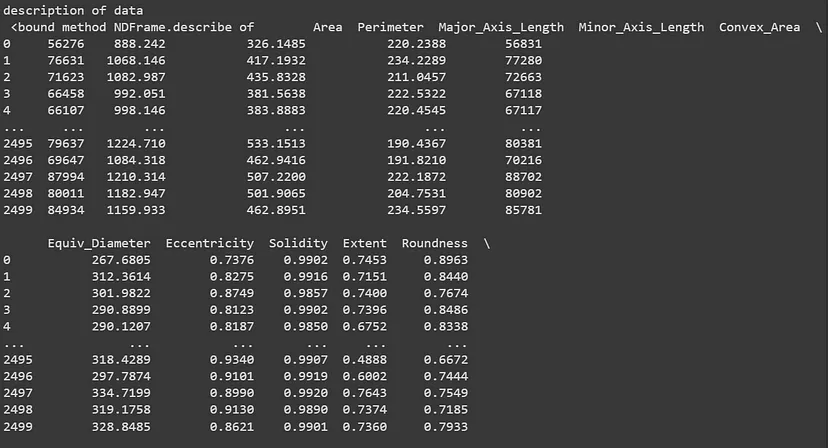
    In the above output, we can see that there are various parameters are used to define the class of pumpkin seeds. Let’s move towards the next part of the article.

    EDA

    In this section, we will try to understand the insights of data. To do so let’s check the shape of the data.

    print(‘shape of data n’,data.shape)


    Output:

    In the data we have, we have 13 columns from which we have one target data and 12 independent variables. Let’s check the description of the data.

    print(‘description of data n’, data.describe)

    Output:

    Let’s check for the null values in the data.

    print(‘Null values in data n’,data.isnull().sum(


    Output:

    There is zero null values in the data so we don’t need to worry about null value analysis.

    print(‘datatype in data n’, data.info(


    Output:

    Here we can see that all independent variables are either in integer format or in float format. Checking the target variable distribution in the data.

    data[‘Class’].value_counts().plot(kind = ‘pie’)

    Output:

    The data we have can be considered a balanced dataset because the number of data points for both classes is almost similar.

    Checking the distribution of the Area variable against both classes of pumpkin seeds.

    fig_size = (15,8)

    plt.figure(figsize=fig_size)

    sns.histplot(data = data , x = ‘Area’,hue = ‘Class’,multiple=’dodge’).set(title = ‘Area Distribution’)

    plt.show()

    Output:

    Here is the distribution of the area of pumpkin seeds, by looking at the above visualization we can say that the highest peak of area for both seeds is not equal, which represents a basic difference between the area of both types of seeds.

    The area of Çerçevelikseeds is higher than the Ürgüp Sivrisi seeds. Similar observations can be made for all the variables. Let’s take a look:

    Perimeter Distribution

    fig_size = (15,8)

    plt.figure(figsize=fig_size)

    sns.histplot(data = data , x = ‘Perimeter’,hue = ‘Class’,multiple=’dodge’).set(title = ‘Perimeter Distribution’)

    plt.show()

    Output:

    It was obvious that the results will be the same as for the Area distribution. Let’s check for the distribution of the major and minor axis lengths.

    fig_size = (15,8)

    plt.figure(figsize=fig_size)

    plt.subplot(1, 2, 1)

    sns.histplot(data = data , x = ‘Major_Axis_Length’,hue = ‘Class’,multiple=’dodge’).set(title = ‘Major Axis Distribution’)

    plt.subplot(1, 2, 2)

    sns.histplot(data = data , x = ‘Minor_Axis_Length’,hue = ‘Class’,multiple=’dodge’).set(title = ‘Minor Axis Distribution’)

    plt.show()

    Output:

    Again the observation is the same that the length of both axes, where Çerçevelikseeds axis lengths are higher. Now we can draw the same plot for the convex areas.

    fig_size = (15,8)

    plt.figure(figsize=fig_size)

    sns.histplot(data = data , x = ‘Convex_Area’,hue = ‘Class’,multiple=’dodge’).set(title = ‘Convex Area Distribution’)

    plt.show()

    Output:

    let’s draw the distribution of eccentricity, solidity, extent and roundness.

    fig_size = (15,8)

    plt.figure(figsize=fig_size)

    plt.subplot(2, 2, 1)

    sns.histplot(data = data , x = ‘Eccentricity’,hue = ‘Class’,multiple=’dodge’).set(title = ‘Eccentricity Distribution’)

    plt.subplot(2, 2, 2)

    sns.histplot(data = data , x = ‘Solidity’,hue = ‘Class’,multiple=’dodge’).set(title = ‘Solidity Distribution’)

    plt.subplot(2, 2, 3)

    sns.histplot(data = data , x = ‘Extent’,hue = ‘Class’,multiple=’dodge’).set(title = ‘Extent Distribution’)

    plt.subplot(2, 2, 4)

    sns.histplot(data = data , x = ‘Roundness’,hue = ‘Class’,multiple=’dodge’).set(title = ‘Roundness’)

    plt.tight_layout()

    plt.show()


    Output:

    Now the observations are changed because eccentricity and solidity distributions are higher for the Ürgüp Sivrisi seeds and the remaining are similar to the others apart from eccentricity and solidity distributions.

    fig_size = (15,8)

    plt.figure(figsize=fig_size)

    plt.subplot(1, 2, 1)

    sns.histplot(data = data , x = ‘Aspect_Ration’,hue = ‘Class’,multiple=’dodge’).set(title = ‘Aspect Ration Distribution’)

    plt.subplot(1, 2, 2)

    sns.histplot(data = data , x = ‘Compactness’,hue = ‘Class’,multiple=’dodge’).set(title = ‘Compactness Distribution’)

    plt.show()

    Output:

    Here again, aspect ratio and compactness distributions are higher for the Çerçevelik seeds. Let’s move toward the correlation analysis.

    However, with decision tree algorithms, we don’t need to perform correlation analysis; to understand the data, we need to do so.

    fig = px.imshow(data.corr(

    fig.show()

    Output:

    The above plot represents how the continuous values are correlated to each other but the visualization is not clear here. So let’s drop some lower correlation values.

    corr = data.corr().abs()

    kot = corr[corr>=.5]

    plt.figure(figsize=(12,8

    fig = px.imshow(corr[corr>=.5])

    fig.show()

    Output:

    Here we can easily see the highly correlated values. Looking at the graph, we can say how two variables are highly correlated. For example, Area and convex Area are correlated. Now, it’s sufficient data analysis to understand the data, and we can move toward our next step.

    Data Preprocessing

    Since the data is not so difficult, we can take only two sub-steps to complete this step:

    • Label encoding
    • Data Splitting

    Label Encoding: in this, we will label encode our class variables using the LabelEncoder function of sklearn in the following way:

    from sklearn.preprocessing import LabelEncoder

    label_encode = LabelEncoder()

    data[‘Class’] = label_encode.fit_transform(data[‘Class’])

    data[‘Class’]

    Output:

    Here we can see that class labels are converted into integer format.

    Data splitting: here we will split the data into two subsets for training and testing purposes. Using the train_test_split we will split this data into a 70:30 ratio.

    from sklearn.model_selection import train_test_split

    X = data.iloc[:,:-1]

    y = data.iloc[:, -1]

    X_train, X_test, y_train, y_test = train_test_split(X, y, test_size = 0.30, random_state = 42)

    Here our dataset is split into two subsets. Let’s move toward the next move.

    Modelling

    Training

    In the above, we have made a train and test set of the data and here we are required to fit a decision tree model on the train data. This can be completed using the below lines of codes:

    from sklearn.tree import DecisionTreeClassifier

    clf = DecisionTreeClassifier(random_state=42)

    clf.fit(X_train, y_train)

    Lets plot the tree using which the clf object has learnt.

    from sklearn.tree import plot_tree

    plt.figure(figsize =(40,20

    plot_tree(clf, feature_names=X_train.columns, max_depth=3, filled=True)


    Output:

    We will need to zoom in on this plot to understand how the data set is split into root nodes and other nodes. The model we used is a simple decision tree model that has taken the aspect ratio as its root node. Let’s check the performance of the model.

    pred = clf.predict(X_test)

    from sklearn.metrics import classification_report, f1_score, precision_score, recall_score, confusion_matrix

    # Metrics

    report = classification_report(y_test, pred)

    cm = confusion_matrix(y_test, pred)

    rfc_f1 = f1_score(y_test, pred)

    rfc_Precision = precision_score(y_test, pred)

    rfc_Recall = recall_score(y_test, pred)

    # Show

    print(report)

    print(‘Confusion Matrix : n{}n’.format(cm

    print(“F1 Score : {:.5}%n”.format(rfc_f1*100

    print(“Precision Score : {:.5}%n”.format(rfc_Precision*100

    print(“Recall Score : {:.5}%”.format(rfc_Recall*100


    Output:

    Here we can see without any modification on the base model, the model has performed well, which we can understand by seeing the accuracy, confusion matrix and F1 score.

    Let’s try to improve the model’s performance using a grid search approach where we are required to give a set of model parameters. This approach will use all possible combinations of the model and will tell the best fit set of parameters for the model.

    params = {

    ‘max_depth’: [2, 3, 5, 10, 20],

    ‘min_samples_leaf’: [5, 10, 20, 50, 100],

    ‘criterion’: [“gini”, “entropy”]

    }

    from sklearn.model_selection import GridSearchCV

    grid_search = GridSearchCV(estimator=clf,

    param_grid=params,

    cv=4, n_jobs=-1, verbose=1, scoring = “accuracy”)

    grid_search.fit(X_train, y_train)

    Output:

    Here, we can see that we have fit 200 possible models. Let’s take a look at the scores of all the models.

    score_df = pd.DataFrame(grid_search.cv_results_)

    print(score_df.head(

    Output:

    Here we can see some results of the grid search approach. Using this data, we can select any of the models but here we will use only the best-fit set of parameters to fit the model. Using the below code we can do so.

    grid_search.best_estimator_

    Output:


    Here, we get the values of the best fit model according to the grid search approach. Now let’s make a model using these parameters.

    best_clf = DecisionTreeClassifier(criterion=’entropy’, max_depth=5, min_samples_leaf=5,

    random_state=42)

    best_clf.fit(X_train, y_train)

    plt.figure(figsize =(40,20

    plot_tree(best_clf, feature_names=X_train.columns, max_depth=3, filled=True)

    Output:

    After zooming in on the plot we can see that this time decision tee has considered the compactness of the seed as its root node. let’s check how the performance of the model has increased this time.

    pred = best_clf.predict(X_test)

    # Metrics

    report = classification_report(y_test, pred)

    cm = confusion_matrix(y_test, pred)

    rfc_f1 = f1_score(y_test, pred)

    rfc_Precision = precision_score(y_test, pred)

    rfc_Recall = recall_score(y_test, pred)

    # Show

    print(report)

    print(‘Confusion Matrix : n{}’.format(cm

    print(“F1 Score : {:.5}%n”.format(rfc_f1*100

    print(“Precision Score : {:.5}%n”.format(rfc_Precision*100

    print(“Recall Score : {:.5}%”.format(rfc_Recall*100

    Output:

    Here we can clearly see that our model’s accuracy and F1 score has increased by 4% and there is more correction in the confusion matrix.

    Final word

    In this article, we looked at an example of working with a decision tree model to see how we can classify pumpkin seeds into two categories using different parameters of seeds. With this, we have performed the EDA step to understand the data. Decision tree algorithms are one of the most used algorithms in real-life use cases, and also a base model for many high-level models like the random forest, XGboost etc., so it helps understand many high-level models.

    You can find our other articles in this link, where we talk about different algorithms, trends and uses of data science and artificial intelligence in real life. The code link, data link and reference articles links are given below for reference.

    References

    About DSW

    Data Science Wizards (DSW) is an Artificial Intelligence and Data Science start-up that primarily offers platforms, solutions, and services for making use of data as a strategy through AI and data analytics solutions and consulting services to help enterprises in data-driven decisions.

    DSW’s flagship platform UnifyAI is an end-to-end AI-enabled platform for enterprise customers to build, deploy, manage, and publish their AI models. UnifyAI helps you to build your business use case by leveraging AI capabilities and improving analytics outcomes.

    Connect us at contact@datasciencewizards.ai and visit us at darkseagreen-chicken-141904.hostingersite.com/

  • A Simple Guide to Data Distribution in Statistics and Data Science

    A Simple Guide to Data Distribution in Statistics and Data Science

    Data distribution plays a major role in defining a mathematical function that can help in calculating the probability of any observation from the data space. There are various uses of data distribution we find in the statistical and data science processes. For example it can describe the grouping of observations in a dataset. This is one of the major statistics topics and helps understand the data better. In this article, we will discuss the statistical data distribution basics using the following points.

    Table of Contents

    • What is distribution?
    • What is density Function?
    • Types of Distribution in Statistics
    1. Gaussian Distribution
    2. Student T-distribution
    3. Chi-squared Distribution
    4. Bernouli Distribution
    5. Binomial Distribution
    6. Poisson Distribution
    7. Exponential Distribution
    8. Gamma Distribution

    What is Distribution?

    We can think of distribution as a function that can be used to describe the relationship between the data points in their sample space.

    We can use a continuous variable like Age to understand this term where the Age of an individual is an observation in the sample space, and 0 to 50 is the extent of the data space. The distribution is a mathematical function that will tell us the relationship of observations of different heights.

    Often generated data follows a well-known mathematical function like The Gaussian Distribution. Generally, these functions are capable of fitting the data if the parameters of the functions are modified. The distribution functions can be used to describe and predict related quantities and relationships between domain and observation.

    What is Density Function?

    The distribution of data points can be described by their density or density function. Using this function, we describe how the proportion of data changes over the range of the distribution. There are mainly two types of density functions:

    • Probability Density Function: Using this function, we can calculate the likelihood of a given value or observation in its distribution space. Often we summarise this for all observations across the distribution space. While we plot this function, we et shape of distribution as a result. Using the plot, we can tell the type of distribution in the data.
    • Cumulative Density Function: Using this function, we can calculate the cumulative likelihood of a given value or observation in the sample space. We can get the cumulative density function by adding all prior observations in the sample space In the probability density function. By plotting this function, we can understand how data is distributed before and after a given value. The plot of this function often varies between 0 to 1 for the distribution.

    One noticeable thing here is that both of these functions are continuous functions and in the case of discrete data probability mass function is equivalent to the probability distribution function.

    Here we get knowledge of distribution and density functions. After that, types of distribution come into the picture. Let’s take a look at different types of distribution.

    Types of Distribution

    There are mainly three types of distribution:

    Gaussian Distribution

    This type of distribution is most commonly found distributions in real-world data. That’s why we sometimes call it the normal distribution. This distribution is named after Carl Friedrich Gauss and mainly focuses on the field of statistics.

    The following two parameters help in defining the gaussian distribution:

    • Mean: a Quantity that is an intermediate value of the large distribution of data observations.
    • Variance: A quantity that helps in measuring the spread between data observations.

    To measure the variance, we often use the standard deviation that defines the spread of data observation from their mean values.

    Using the below code, we can make data where observations are normally distributed and plotting them gives us a perfect example of normal or gaussian distributed data.

    #importing libraries

    import numpy as np

    import matplotlib.pyplot as plt

    from scipy import stats

    #making data

    array = np.arange(-10,10,0.001)

    data = stats.norm.pdf(array, 0.0, 2.0 )

    #ploting probablity density function

    plt.plot(array, data)

    Output:

    Here mean of the data is zero, and the standard deviation is two. For the same data, we can also plot the cumulative density function.

    CDF = stats.norm.cdf(array, 0.0, 2.0 )

    plt.plot(array, CDF)

    Output:

    As defined in the code here in the plot, we can see that 50% of the data is lying below the mean(0) point.

    Student T-distribution

    Estimating the mean of a normal distribution with samples of different sizes is the reason behind this distribution. We can also call it t-distribution. Calculation of this distribution is helpful when describing the error in estimating population statistics for data drawn from Gaussian distributions, and the sample size is taken into account.

    The degree of freedom can be used to describe the t-distribution. Also, the calculation of the degree of freedom is one of the main reasons behind using the t-distribution. Using the degree of freedom for any observation helps in describing the population quantity.

    For example, if the degree of freedom is n, then we can use n observation from the data can be used to calculate the mean of the data.

    Two calculate the observation in a t-distribution, we need to know the observations n the gaussian distribution so that we can define the interval for the population mean in the normal distribution. Observations in t-distribution can be calculated using the below formula:

    Data = ( X — mean(X)) / S / sqrt(N) )

    Where,

    X = observations from normal or gaussian distributed data.

    S = standard deviation of X.

    N = total number of observations

    We can calculate and plot the PDF and CDF for this distribution using the following lines of code.

    Calculating Probably Density Function

    DOF = len(array) — 1

    PDF = stats.t.pdf(array, DOF)

    plt.plot(array, PDF)

    Output:


    Calculating Cumulative Density Function

    CDF = stats.norm.cdf(array, 0.0, 2.0 )

    plt.plot(array, CDF)

    Output:

    Chi-Squared Distribution

    This type of data distribution helps in describing the quantity of uncertainty of data drawn from the Gaussian distribution. One of the best examples of a statistical method is the chi-squared test, where chi-squared distribution is used often. This distribution can also be used in the derivation of the t-distribution. Like t-distribution, this can also be described using the degree of freedom of observation.

    Observation in this distribution can be calculated as the sum of k-squared observations drawn using the Gaussian distribution. Mathematically,

    Where,

    Z1, …, Zk are samples that are gaussian distributed, and with the degree of freedom k, we can denote chi-squared distribution as

    Again, like t-distribution, data usually do not follow this distribution here. Instead, observations are drawn from chi-squared distribution in statistical method calculation for a part of gaussian distributed data.

    We can calculate and plot the PDF and CDF for this distribution using the following lines of code.

    array = np.arange(0,50,0.1)

    DOF = 10

    PDF = stats.chi2.pdf(array,DOF)

    plt.plot(array,PDF)

    Output:

    Here we can see that as given the degree of freedom, the distribution changes because the sum of the square random observations from the normally distributed data is under the degree of freedom(10 in this case). However, it is bell-curved but not symmetric.

    Calculating the cumulative density function:

    CDF = stats.chi2.cdf(array,DOF)

    plt.plot(array,CDF)

    Output:

    Here we can see that there is a fat tail at the right of the distribution, which is continued to the last point.

    Bernouli distribution

    This type of data distribution mainly comes into the picture when there are only two possible outcomes, and this distribution describes the probability of an event that has been reported only once.

    The example of outcomes can be success and failure, 0 and 1, yes or no. to describe this distribution, we use only one parameter, which is the probability of success. Using the below lines of code, we can create a situation with Bernoulli distribution.

    p = 0.5

    variable = stats.bernoulli(p)

    fig, ax = plt.subplots(1, 1)

    x = [0, 1]

    ax.vlines(x, 0, variable.pmf(x), label=’probability’)

    ax.legend(loc=’best’, frameon=False)

    plt.show()

    Output:

    We can simply consider the above example as a result of a coin flip, where we can consider any side as a success, and the probability of success will be 0.5.

    Binomial distribution

    The above distribution was repeated only once but this type of distribution models the number of successes in a situation of repeated Bernoulli experiment. This directly focuses on a success count instead of focusing on the probability of success.

    As discussed above, this distribution can be described using two parameters:

    • Number of experiments
    • Probability of success

    We can use the below line of codes to take an idea of the binomial distribution.

    n = 10 #number of events

    p = 0.5 #probablity of success

    array = np.linspace(0, 10, 11)

    fig, ax = plt.subplots(1, 1)

    variable = stats.binom(n, p)

    ax.vlines(array, 0, variable.pmf(x), label = ‘probability’)

    ax.legend(loc=’best’, frameon=False)

    plt.show()


    Output:

    We can compare the above example with flipping a coin ten times, and the graph gives us the probability for each number of success out of 10.

    Poisson Distribution

    This distribution includes the time parameter with it. Till now, we have seen distribution for one event and a number of events, but here this distribution describes the number of events in a time period. A simple example of this type of case is the number of vehicles passing through a toll booth in 1 hour.

    In the extension of the example, we can say there is an average value of vehicles passing through toll booths for different units of time. To describe this distribution, we only need the time parameter. Let’s take a look at the below codes:

    time = 4

    array = np.linspace(0, 15, 16)

    fig, ax = plt.subplots(1, 1)

    variable = stats.poisson(time)

    ax.vlines(x, 0, variable.pmf(x), label = ‘probability’)

    ax.legend(loc=’best’, frameon=False)

    plt.show()

    Output:

    The example can be compared to a toll booth where, every one-hour time interval, a number of cars are passing.

    Exponential distribution

    From the above distribution, if we replace the event per unit time with the waiting time between events, we get the exponential distribution. Simple by inversing the time parameter in the Poisson distribution, we can get describe this distribution.

    import pandas as pd

    time = 4

    n_simulated = 10000000

    random_waiting_times = stats.expon(scale = 1 / time).rvs(n_simulated)

    pd.Series(random_waiting_times).hist(bins = 40)


    Output:

    Here we need to read the x-axis as the percentage of unit time. Here we have 4 events to take place in one hour.

    Gamma distribution

    This type of distribution can be described by the wait time for an event to occur. We can think of it as a variation of exponential distribution because it takes parameters for the number of events to wait for with the lambda parameter of the exponential distribution.

    We can take an example from the bus that is waiting to run when the number of passengers is not filled in it. Let’s take a look at the below graph.

    time = 4 # event rate of customers coming in per unit time

    n_simulated = 10000000

    waiting_times = stats.gamma(10, scale = 1 / time).rvs(n_simulated)

    pd.Series(waiting_times).hist(bins = 20)

    Output:

    In the above graph, we can see that the peak is around 2.5, which means the waiting time for ten passengers to come on the bus is 2.5 times the unit time of 2 minutes.

    Final words

    In this article, we have discussed data distribution, Density Functions and Type of Distribution in data. In statistical and data science processes, these all things come in the early stages of processes that helps us in generating more knowledge about the data we have. Since understanding the data domain and statistics are important tasks for a data scientist, with the help of the above-given knowledge, we can understand the statistics of our data.

    References

    About DSW

    Data Science Wizards (DSW) is an Artificial Intelligence and Data Science start-up that primarily offers platforms, solutions, and services for making use of data as a strategy through AI and data analytics solutions and consulting services to help enterprises in data-driven decisions.

    DSW’s flagship platform UnifyAI is an end-to-end AI-enabled platform for enterprise customers to build, deploy, manage, and publish their AI models. UnifyAI helps you to build your business use case by leveraging AI capabilities and improving analytics outcomes.

    Connect us at contact@datasciencewizards.ai and visit us at darkseagreen-chicken-141904.hostingersite.com/