Machine learning models are powerful tools that can learn from data and make predictions or decisions. However, the effectiveness of the models in production isn’t guaranteed forever due to many factors.
Let’s imagine a self-driving car. It is meticulously trained on a vast dataset of clear weather conditions, including sunny days, light rain, and even the occasional fog. The car’s algorithms have learned to navigate these conditions safely and efficiently. However, on a day with a sudden downpour and strong winds, the car’s sensors struggle to perceive the road markings and surrounding environment. The training data, optimized for typical weather patterns, may not be enough to ensure a safe and smooth driving experience in unexpected storms. Similarly, ML models, trained on historical data, can underperform in production when faced with unforeseen changes in the real world, leading to model drift.
Understanding the Drifts:
Concept Drift
Concept drift, also known as model drift, occurs when the underlying relationship between input and output data itself changes. This means that the relationship between the input data and the output data that the model learned during training no longer holds true for the new data that the model is applied to.
Concept drift can happen for various reasons, such as:
Changes in user behaviour or preferences over time.
Changes in environmental conditions or external factors
Changes in business rules or objectives
Changes in target variable definition.
For example: Imagine that an ML model was trained to detect spam emails based on the content of the email. If the types of spam emails that people receive change significantly, the model may no longer be able to detect spam accurately. Here, the concept of “spam” has evolved.
Data Drift
Data drift, also known as covariate shift, occurs when the distribution of the input data that an ML model was trained on differs from the distribution of the input data that the model is applied to in production. This can manifest in various ways, such as changes in the distribution of features (i.e., how the data points are spread out), the emergence of new features, or the disappearance of existing features.
Data drift can happen for various reasons, such as:
Changes in data collection methods or sources
Changes in data quality or preprocessing
Changes in user behaviour or preferences
Changes in business logic
For example: A model was trained to predict customer churn based on purchase patterns. If new competitors emerge or customer preferences evolve, the data distribution (i.e., how the data points for factors like purchase frequency and amount are spread out) changes. This throws off the model’s predictions, as it was trained on a different data landscape.
The Impact of Drifts:
Unidentified and unaddressed drift can lead to:
Reduced Accuracy: Predictions become unreliable, impacting business decisions and the user experience.
Negative Consequences: In critical applications, like fraud detection or medical diagnosis, drift can have significant real-world consequences.
Loss of Trust: Users may lose trust in the system if it consistently delivers inaccurate or irrelevant results.
Missed Opportunities: Drift can prevent models from identifying new trends or patterns, leading to missed opportunities for businesses.
How to Detect Model Drift?
Model drift can be a serious problem for machine learning systems that are deployed in real-world settings, as it can lead to inaccurate or unreliable predictions or decisions. Therefore, it is important to constantly monitor the performance of machine learning models over time and detect any signs of model drift.
There are different methods and techniques to detect model drift, such as:
Performance metrics: Comparing the performance metrics (such as accuracy, precision, recall, etc.) of the model on new data with its performance on historical data or a baseline.
Statistical tests: Applying statistical tests (such as hypothesis testing, chi-square test, etc.) to compare the distributions of input data and the training data over time and check for any significant differences.
Drift detection algorithms: Using specialized algorithms (such as ADWIN, DDM, EDDM, etc.) that can automatically detect changes in data distributions or concepts over time and trigger alerts or actions.
Master Drift Detection with UnifyAI
UnifyAI is assisting organizations in smoothly transitioning their machine-learning models from the experimental phase to production. However, the journey doesn’t conclude there; maintaining vigilance over the performance of production models is crucial. UnifyAI implements regular statistical tests across all deployed models to address the data drift challenge. These tests meticulously compare the distribution of incoming inference data with the distribution of the data on which the model was originally trained. By actively identifying and addressing drift in production, UnifyAI safeguards against the degradation of models over time, ensuring sustained effectiveness and reliability of the models in real-world applications.
To sum up, the dynamic nature of real-world environments poses a constant threat to the stability and accuracy of machine learning models. The concept and data drift phenomena highlight the need for a vigilant approach to model monitoring. By actively addressing drift in production, UnifyAI not only safeguards the models against degradation but also ensures that they remain adaptive, resilient, and reliable in the face of evolving conditions. This proactive stance not only upholds the integrity of predictions but also nurtures confidence in users, fostering trust and enabling organizations to harness the full potential of machine learning in practical, real-world applications.
Want to build your AI-enabled use case seamlessly and faster with UnifyAI?
Authored byRahul Pal, MLOps Engineer at Data Science Wizards (DSW), sheds light on the challenges posed by model drift that emerge once the models are actively serving in production. The article also emphasizes the importance of proactive monitoring and introduces UnifyAI’s solutions to counter the drifts.
About Data Science Wizards (DSW)
Data Science Wizards (DSW) is a pioneering AI innovation company that is revolutionizing industries with its cutting-edge UnifyAI platform. Our mission is to empower enterprises by enabling them to build their AI-powered value chain use cases and seamlessly transition from experimentation to production with trust and scale.
To learn more about DSW and our ground-breaking UnifyAI platform, visit our website at darkseagreen-chicken-141904.hostingersite.com/. Join us in shaping the future of AI and transforming industries through innovation, reliability, and scalability.
MLOps, short for Machine Learning Operations, is a set of practices, principles, and tools aimed at operationalizing and streamlining the deployment, monitoring, and management of machine learning models in production environments. It borrows concepts from DevOps and applies them to the machine learning lifecycle. However, the machine learning lifecycle is different from software development. Machine learning modelling involves solving a problem where the solution is not programmed but learned from the data. The model aims to find patterns and trends and make predictions based on the data. Software development is more focused on building applications specific to the requirements to meet user needs. ML models can be considered as a black box that can be understood by the data exploration and steps involved to create an ML model, unlike software development, where the application is a white box whose functioning can be programmed specifically to the user’s needs.
There are differences in the two concepts, as both have different tasks but both deploy the same steps in the management cycles. The core concepts remain the same in both, such as:
Automation: Both heavily utilize automation to reduce manual work and improve efficiency. DevOps tools automate tasks like code building, testing, and deployment, while MLOps tools automate aspects like data pipeline management, model training, and deployment.
Single platform: MLOps and Dev Ops both serve as a single platform to orchestrate different ML models and software development and deployment respectively.
Continuous Integration and Continuous Deployment (CI/CD): The CI/CD practices enable rapid and reliable software and model delivery. CI/CD pipelines automate the process of building, testing, and deploying software and machine learning models, ensuring that changes are quickly integrated and delivered to production environments.
Version Control: Version control is essential in both MLOps and DevOps to track changes to code, models, configurations, and infrastructure.
Collaboration: Both emphasize close collaboration between different teams. In DevOps, development, operations, and security teams work together. MLOps extends this collaboration to include data scientists and machine learning engineers alongside developers and operations teams.
Infrastructure as Code: Infrastructure as code (IaC) is a practice where you manage and provision your IT infrastructure through machine-readable definition files, instead of relying on manual processes or physical configuration. Both MLOps and DevOps embrace the concept of IaC to manage and provision infrastructure resources programmatically.
Monitoring and Logging:Both emphasize the importance of monitoring the deployed applications or models. Monitoring tools are used to track metrics, detect anomalies, and generate alerts while logging tools capture and analyze system logs for troubleshooting and analysis. Both MLOps and DevOps incorporate feedback loops to continuously improve processes and systems.
Feedback Loops: Feedback from users, stakeholders, and automated testing is used to identify areas for improvement, prioritize enhancements, and drive iterative development and deployment cycles. By establishing a feedback loop, you can create a virtuous cycle where models constantly learn from new data and feedback, leading to continuous improvement in their accuracy and effectiveness.
Deep Dive into the Complete MLOps Life Cycle:
Data Ingestion: The first step in any ML model development is to gather the required data. Data ingestion is the critical first step in the MLOps lifecycle, laying the groundwork for successful machine learning model development and deployment. It’s the process of acquiring, extracting, transforming, and loading (ETL) data from various sources into a usable format for machine learning models. MLOps pipelines ensure that data is ingested reliably and consistently, leading to high-quality data for model training. This translates to more accurate, reliable, and robust models. MLOps tools automate the data ingestion process, making it scalable and repeatable, reducing manual effort and human error. This allows for efficient handling of large and diverse datasets.
Feature Selection and Feature Store: Once the data is available, feature selection focuses on identifying and selecting the most relevant and informative features from your raw data. By applying feature selection techniques consistently across the development lifecycle, MLOps ensures that models are trained and evaluated based on the same set of relevant features, leading to reproducible results and easier collaboration. MLOps pipelines automate feature selection tasks, such as feature pre-processing, transformation, and selection algorithms. This streamlines the development process and reduces manual effort.Feature store acts as a single source of truth for all pre-computed features, enabling centralized management, access, and sharing across different stages of the MLOps pipeline. This fosters collaboration and ensures everyone uses consistent features. By storing features pre-computed, you avoid redundant calculations during model training and serving, saving time and resources.
Model Development and Experimentation: Model development and experimentation are core pillars of MLOps, focusing on the iterative process of building, testing, and refining machine learning models. MLOps integrates with experimentation frameworks that enable data scientists to run multiple experiments in parallel, and compare different model architectures, hyperparameter settings, and feature selections. This facilitates efficient exploration of the model space and rapid identification of the best-performing models. By facilitating rapid experimentation and comparison, MLOps allows teams to identify and deploy models with superior performance.
Evaluation: Evaluation provides concrete metrics (e.g., accuracy, F1-score, Jaccard similarity, mean square error, tf-idf) that quantify how well the model performs on its intended task and whether it meets the necessary requirements. Evaluation helps reveal the specific areas where the model excels or needs improvement, leading to more informed decisions about model refinement or re-training. MLOps platforms provide tools for automated model evaluation as part of the model development workflow. By continually assessing and refining your models within the MLOps framework, you can ensure that your machine learning systems maintain optimal performance, deliver real business value, and evolve effectively to meet changing requirements.
Model Repository/Version Control: Version control goes beyond simply extending experimentation in MLOps. MLOps tools ensure proper version control of the model code, data, and configuration files. This allows tracking changes, reverting to previous versions if needed, and maintaining a clear lineage of the model development process. By tracking and storing different versions of models and their associated results, you easily compare and analyze different experiments, helping you identify the best-performing configuration. If an issue arises with a deployed model, you easily revert to a previous version known to be stable, minimizing downtime and impact on production.
Model Deployment: In the world of MLOps, model deployment marks the crucial transition point where a meticulously trained machine learning model is brought to life in a production environment, allowing it to interact with real-world data and generate valuable insights. MLOps tools package the model code, dependencies, and configuration files into standardized containers like Docker containers. This simplifies deployment across diverse environments and ensures consistency. MLOps platforms act as the orchestrator, managing the sequence of steps involved in deploying the model. MLOps leverages infrastructure as code (IaC) principles to automate the provisioning of necessary resources for running the model in production. Standardized processes ensure every deployment follows the same steps across environments, minimizing errors and promoting reliable model behavior. Automated deployments allow for easy scaling up or down of model instances based on changing workloads, ensuring optimal resource utilization and responsiveness.
Model Monitoring: Model monitoring is a crucial aspect of MLOps, focusing on continuously observing and evaluating the behavior and performance of deployed machine learning models in production. Over time, model performance can degrade due to factors like data drift (changes in underlying data distribution) or concept drift (changes in the problem itself). Monitoring helps identify such issues early on, allowing for timely intervention and re-training. Monitoring helps identify potential biases that may creep into the model during training or deployment, enabling actions to mitigate them and maintain fair and responsible AI practices. By monitoring infrastructure health (CPU, memory, network usage), you identify potential bottlenecks or resource constraints that might impact model performance or even cause outages. Monitoring resource usage helps you identify over-provisioned or under-utilized resources, allowing for efficient allocation and cost optimization.
Feedback Loops:In the MLOps lifecycle, feedback loops are not isolated stages but rather encompass the entire cycle, forming a continuous process that bridges the gap between development, deployment, and monitoring. Feedback loops enable the collection of feedback from various sources, including users, stakeholders, monitoring systems, and automated testing, to improve model performance and relevance. Feedback loops bridge the gap between model development, deployment, and monitoring. Insights from monitoring in production are fed back to the development stage, informing model updates and improvements. In essence, model monitoring acts as the eyes and ears in MLOps, providing insights into the model’s health and performance. Feedback loops, on the other hand, are the actionable steps taken based on those insights, forming a continuous cycle of improvement for your machine-learning models.
Governance and Compliance: MLOps frameworks include mechanisms for enforcing governance policies and ensuring compliance with regulatory requirements. This includes tracking data lineage, managing access controls, and implementing security measures to protect sensitive data. MLOps frameworks offer mechanisms for granular access control to Restrict access to sensitive data based on user roles and permission and limit access to deploying, modifying, or retraining models to authorized personnel. Enforcing governance policies helps mitigate bias, ensure fairness, and promote explainability in models. Adhering to relevant regulations like GDPR and CCPA regarding data privacy and security requires robust control mechanisms. Ensuring data protection and responsible AI practices fosters public trust and transparency in the development and deployment of models.
Scalability and Resource Management: MLOps systems adjust resources automatically based on the fluctuating demands of the model, optimizing resource utilization and cost efficiency. Utilizing containerization technologies like Docker (or cloud) allows packaging models and their dependencies for efficient and scalable deployment across various environments. MLOps practices ensure optimal allocation of resources like CPU, memory, storage, and network bandwidth to models in production based on their requirements. By monitoring resource utilization and scaling resources efficiently, MLOps aims to minimize infrastructure costs associated with model deployment.
Documentation and Collaboration: Effective documentation and collaboration are cornerstones of a successful MLOps practice. Comprehensive documentation provides a clear record of the model development process, data lineage, and decision-making rationale. This promotes transparency and facilitates understanding of the model’s purpose, limitations, and potential biases. MLOps practices establish a consistent format and structure for documentation across all models and projects within the organization, enabling an effective communication channel. MLOps utilizes tools and frameworks that can automatically generate documentation based on code and configurations, saving time and effort.
Model Retirement: In MLOps, model retirement refers to the decommissioning of a machine learning model that is no longer considered valuable or effective for its intended purpose. This is a critical stage in the MLOps lifecycle, as it ensures resources are allocated efficiently and avoids relying on outdated or underperforming models that cause potential risks associated with using outdated models, such as inaccurate predictions or ethical concerns, leading to overall cost reduction. By focusing resources on better-performing models, the MLOps process ensures overall higher reliability and accuracy in deployed models. MLOps uses trigger alerts when thresholds indicative of potential retirement of ML models are met.
How can you simplify MLOps with UnifyAI?
With UnifyAI, organizations today are seamlessly building the MLOps pipeline to experiment with AI models which includes training, deployment, managing and monitoring AI models. The UnifyAI core engine acts as a central orchestrator for the whole MLOps pipeline, which handles model deployment, model monitoring & real-time inference. It facilitates the following:
An integrated development environment is provided to the data scientist/user to experiment with and train AI models
Data scientists/users can store the experiment results in the model registry & choose the candidate model for registration along with versioning capability through metric comparison
One-click model deployment from the UnifyAI user interface
It handles the metadata required for inference for deployed models
A user-friendly user interface that handles inference requests for UnifyAI platform, including getting required data from the feature store
A user-friendly user interface to evaluate and monitor model performance
Want to build your AI-enabled use case seamlessly and faster with UnifyAI? Book a demo,today.
Blog authored by Laxman Singh, Data Scientist at Data Science Wizards (DSW), this article delves into the realm of MLOps (Machine Learning Operations), extending DevOps concepts and enabling managing the lifecycle of ML applications.
About Data Science Wizards (DSW)
Data Science Wizards (DSW) is a pioneering AI innovation company that is revolutionizing industries with its cutting-edge UnifyAI platform. Our mission is to empower enterprises by enabling them to build their AI-powered value chain use cases and seamlessly transition from experimentation to production with trust and scale.
To learn more about DSW and our ground-breaking UnifyAI platform, visit our website at darkseagreen-chicken-141904.hostingersite.com/. Join us in shaping the future of AI and transforming industries through innovation, reliability, and scalability.
One of the challenges to understanding MLOps is that the term itself is used very loosely in the ML community. In general, we should think about MLOps as an extension of DevOps methodologies but optimized for the lifecycle of ML applications. This definition makes perfect sense if we consider how fundamentally different the lifecycle of ML applications is compared to traditional software programs. For starters, ML applications are composed of both models and data, and they include stages such as training, feature engineering, hyperparameter optimization etc. that have no equivalence in traditional software applications.
Just like DevOps, MLOps looks to manage the different stages of the lifecycle of ML applications. More specifically, MLOps encompasses diverse areas such as data/model versioning, continuous integration, model monitoring, model testing, and many others. In no time, MLOps evolved from a set of best practices into a holistic approach to ML lifecycle management.
Fundamentally, MLOps is based on the following principles:
One machine learning platform for many learning tasks: Providing a consistent architecture for automating the lifecycle of different types of machine learning models.
Continuous training: Support a pipeline for enabling continuous training workflows of models.
Easy-to-use configuration and tools: Configuration management is essential to automating the lifecycle of machine learning models.
Production-level reliability and scalability: Having a series of building blocks to ensure that models built can operate at scale in production.
MLOPs Key Components
MLOps includes several key components of the lifecycle of machine learning models.
1. Model Monitoring Considered by many to be the cornerstone of MLOps, model monitoring is one of the essential building blocks of any ML pipeline. In some ways, ML monitoring can be viewed as the next phase of the application performance monitoring (APM) space that has accompanied the evolution of software technology trends. ML is sufficiently unique that is likely to create a new generation of monitoring platforms that are specifically optimized for the performance of ML models.
In data science, models are not static artifacts but entities that require constant oversight. Model monitoring serves as the vigilant guardian, providing insights into the performance and behavior of deployed models in production environments. By monitoring key metrics and detecting anomalies, organizations can proactively identify issues such as model drift, data drift, thus mitigating potential risks and ensuring optimal performance over time. Additionally, tracking auxiliary metrics like latency and throughput offers insights into operational efficiency.
2. Feature Stores Feature stores have rapidly become a key component of MLOps infrastructures. This is not surprising if we consider that many challenges in the lifecycle of ML models revolve around data and features. In any large ML team, data scientists spend most of their time extracting, selecting, and transforming data into features and then figuring out how to incorporate those features into production-ready ML models. From an ML architecture standpoint, a feature store can be seen as the missing link between feature engineering and feature serving. They facilitate collaboration and knowledge sharing among data scientists by enabling the reuse of curated features across machine learning models. This not only accelerates development cycles but also ensures consistency and reproducibility in model training.
The main capabilities include Feature Transformation, Feature Storage, Feature Serving, feature versioning, usage tracking, and lifecycle monitoring.
3. Model Serving Model deployment/serving can be considered one of MLOps pipelines most challenging aspects. This is partly because model serving architectures have little to do with data science and are more related to ML engineering techniques. It involves deploying machine learning models into production environments, where they can generate predictions in response to incoming data. This process requires careful consideration of factors such as scalability, latency, and reliability to ensure optimal performance and user experience.
Some ML models take hours to execute, requiring large computation pipelines, while others can be executed in seconds on a mobile phone. A solid ML serving infrastructure should be able to adapt to diverse requirements from ML applications. Leveraging technologies such as containerization and microservices architecture, data scientists can deploy models at scale while maintaining flexibility and agility.
4. Model Packaging Model packaging involves encapsulating trained models along with any necessary dependencies into a portable format suitable for deployment across diverse environments.
Effective model packaging facilitates seamless integration of machine learning models into production systems, minimizing compatibility issues and deployment complexities. Technologies such as Docker containers have emerged as popular solutions for packaging machine learning models, offering consistency and reproducibility across different computing environments.
By encapsulating models and dependencies, organizations can streamline deployment workflows and promote collaboration across teams. Additionally, container orchestration platforms like Kubernetes provide robust infrastructure for deploying and managing containerized machine learning applications at scale. Leveraging these platforms, data scientists can orchestrate complex deployment scenarios, automate scaling, and ensure high availability of deployed models.
5. ML Model Versioning Versioning is one of those aspects that we tend to ignore until they become a problem. This is partly because versioning is rarely an issue when we talk about a handful of models but can become a total nightmare in a medium to large-scale ML infrastructure. Paradoxically, versioning is an element every software developer is familiar with as it’s the cornerstone of processes such as continuous integration or deployment, which rule the lifecycle of most modern software applications. However, version control in ML solutions takes a different connotation. What makes version control different in ML models is that we are not talking only about code versioning but also about data and trained model versioning.
ML model versioning involves systematically tracking changes to models over time, including modifications to code, data, hyperparameters, and training processes. Effective versioning allows data scientists to revisit and reproduce previous model iterations, facilitating experimentation and comparison of different approaches. By associating each model version with metadata such as training data, evaluation metrics, and deployment details, data science teams can ensure accountability and traceability throughout the model development lifecycle.
6. A/B Testing for ML Models A/B testing is a well-established practice in modern software applications, but it’s not trivial when it comes to ML pipelines. After all, testing an ML model does not only involve testing the model itself but also the corresponding datasets and hyperparameters. From that perspective, A/B testing in ML models is relatively different and more complex than in traditional software applications. In the context of machine learning, it enables data scientists to assess the impact of model changes, feature modifications, or hyperparameter tuning on key performance indicators such as accuracy, conversion rates, or user engagement. By randomly assigning users or data points to different model variants, organizations can gather statistically significant insights into the relative effectiveness of each approach.
Moreover, A/B testing provides a rigorous framework for validating model improvements before rolling them out to production, mitigating the risk of deploying suboptimal solutions. It also facilitates continuous experimentation and iteration, allowing data scientists to refine models iteratively based on real-world feedback.
7. CI/CD in ML Solutions CI/CD is a well-established concept in traditional software development. But in the world of ML, it is taking its first steps. Like in traditional software, CI/CD in ML focuses on streamlining the ML solutions’ delivery and management, but the specifics look quite different from established CI/CD concepts. Establishing a CI/CD pipeline for ML applications requires considering aspects such as model training and optimization, which have no equivalent in traditional software systems. At a high level, here are some of the components of ML CI/CD pipelines:
Continuous Integration: This phase includes stages such as model unit testing, training convergence validation, and integration between the different components of the solution. Continuous Delivery: This phase includes infrastructure validation, model performance testing, retraining processes, model serving, and monitoring.
In CI/CD pipelines for ML solutions, automation plays a central role, facilitating seamless integration of code changes, feature updates, and model improvements into production environments. Automated testing frameworks validate model performance against predefined metrics, enabling data scientists to maintain high-quality standards. By embracing CI/CD practices, organizations can accelerate time-to-market for ML solutions, iterate more rapidly in response to changing requirements, and maximize the value derived from data-driven initiatives.
Simplify MLOps with UnifyAI
With UnifyAI, organizations today are seamlessly building the MLOps pipeline to experiment with AI models which includes training, deployment, managing and monitoring AI models. The UnifyAI core engine acts as a central orchestrator for the whole MLOps pipeline, which handles model deployment, model monitoring & real-time inference. It facilitates the following:
An integrated development environment is provided to the data scientist/user to experiment with and train AI models.
Data scientists/users can store the experiment results into model registry & choose the candidate model for registration along with versioning capability through metric comparison.
One click model deployment from the UnifyAI user interface.
It handles metadata required for inference for deployed models.
A user-friendly user interface that handles inference requests for UnifyAI platform, including getting required data from the feature store.
A user-friendly user interface to evaluate and monitor model performance.
Components of the UnifyAI MLOps pipeline:
1. UnifyAI IDE: UnifyAI IDE provides an environment for data scientists/users to experiment with AI models and log those to the model registry. It helps in following way,
Features can be extracted from the Feature store which will be further used for training purposes. The model will be tested against applicable metrics. Models & their metrics will be pushed to the model registry.
2. UnifyAI Model Registry & Repository: The main purpose of model registry is to store experiment results. Different hyper-parameters are tested on the specific models and the final chosen models are registered. Model related artifacts are stored in the model repository. It helps in the following ways:
Experiments, including different hyper-parameters logged during model experimentation, can be traced through its user interface. Specific models can be registered in the model registry, along with the processing required for models with a version tag. Integration with the UnifyAI core engine helps to enable automated model deployment.
3. UnifyAI Model Deployment: Model Deployment facilitates a one click deployment facility for the registered models. UnifyAI Core Engine handles the task of automated model deployment as well as model inference. It helps in the following way,
Once the model is registered, using the UnifyAI user interface, scientists and users can deploy the model with just one click. Deployed model supports single as well as batch inferences. Apart from this, models are deployed as REST/GRPC microservice containers, which add auto scaling, load balancing, etc. functionalities to it.
4. UnifyAI Monitoring: Monitoring provides a user-friendly interface for users to visualise the model performance in the real-time production environment. It helps in the following way,
Monitoring provides two main two types of metrics: Data Drift metrics and API-level metrics. Data drift metrics help data scientists/users to identify the drift in data at the time of inference, while API metrics provide the API level performance of models such as error rate, latency etc.
Want to build your AI-enabled use case seamlessly and faster with UnifyAI?
Talk to us today.
Authored by Hardik Raja, Senior Data Scientist at Data Science Wizards (DSW), this article delves into the realm of MLOps (Machine Learning Operations), extending DevOps concepts and enabling managing the lifecycle of ML applications. It covers various aspects including version control, CI, monitoring, continual training, Configurability, scalable production deployment and how they are streamlined through UnifyAI; Using it, enterprises can accelerate the development of Machine learning solutions, paving the way for enhanced creativity, efficiency, and competitiveness.
About Data Science Wizards (DSW)
Data Science Wizards (DSW) is a pioneering AI innovation company that is revolutionizing industries with its cutting-edge UnifyAI platform. Our mission is to empower enterprises by enabling them to build their AI-powered value chain use cases and seamlessly transition from experimentation to production with trust and scale.
To learn more about DSW and our ground-breaking UnifyAI platform, visit our website at darkseagreen-chicken-141904.hostingersite.com/. Join us in shaping the future of AI and transforming industries through innovation, reliability, and scalability.
In the age of rapid technological advancement, one realm that has captured the imagination of both researchers and industry experts alike is Generative AI. This groundbreaking technology promises to revolutionize the way we create, design, and interact with digital content. Let’s delve deeper into the intricacies of Generative AI and uncover its significance in today’s world.
In a world where creativity knows no bounds, there has always been a quest to imbue machines with the ability to generate content autonomously. Generative AI emerges as the answer to this quest, driven by the need to automate and streamline creative processes across various domains. Whether it’s generating art, music, text, or even entire virtual worlds, Generative AI holds the promise of unlocking unprecedented levels of creativity and innovation.
Understanding Generative AI and Its Benefits
Generative AI stands as the frontier of innovation, employing advanced algorithms and models to autonomously generate content that mirrors human creativity. Through the utilization of deep learning and neural networks, Generative AI can craft text, images, audio, and more with remarkable realism and ingenuity. The benefits of Generative AI extend far and wide – it not only enhances productivity and creativity but also facilitates personalized experiences and aids in problem-solving tasks across diverse industries. By harnessing the power of Generative AI, businesses can unlock new avenues for innovation and differentiation in an increasingly competitive landscape.
Traditional Approaches towards Generative AI Development
Traditionally, the development of Generative AI solutions demanded extensive manual effort, often involving laborious data annotation and algorithm tuning.
Ideation: The journey begins with formulating an idea. This could be inspired by a specific problem you want to solve or a creative concept you wish to explore.
Data Collection and Preparation: Gathering relevant data. High-quality data is crucial for training your generative AI model. Clean, preprocess, and organize the data to ensure its suitability.
Model Design and Training: Develop the architecture of your generative AI model. Choose appropriate techniques (such as GANs, VAEs, or transformers) and train the model using the collected data. Use existing models such as LLama, Mixtral, Mistral, etc. Fine-tuning and hyperparameter tuning are essential during this phase.
Model Evaluation: Assess the performance of your trained model. Metrics like accuracy, diversity, and novelty are relevant. Iterate and improve the model based on evaluation results.
Deployment: Finally, deploy the generative AI model in a production environment. Monitor its performance, address any issues, and continue to enhance it as needed.
Challenges Faced by Enterprises in the Adoption of Generative AI:
Data Privacy Concerns: Enterprises must navigate the complexities of data privacy regulations when collecting and utilizing data for Generative AI applications.
Ethical Considerations: The ethical implications of Generative AI, including issues related to bias, fairness, and accountability, present significant challenges for enterprises.
Algorithmic Biases: Ensuring fairness and transparency in Generative AI models is crucial to mitigate algorithmic biases that could perpetuate existing societal inequalities.
Robust Evaluation Metrics: Developing robust evaluation metrics to assess the performance and reliability of Generative AI models remains a challenge for enterprises, particularly in subjective tasks such as content generation and creative design.
Prompt Engineering: Crafting effective prompts for Generative AI models requires domain expertise and creativity, posing a challenge for enterprises seeking to leverage prompt-based customization effectively.
Custom Training and Fine-tuning: The inability to custom train or fine-tune pre-existing Generative AI models may limit enterprises’ ability to tailor solutions to their specific use cases and requirements.
Amidst these challenges, the soaring investments and strategic initiatives by major consultancy firms underscore the transformative potential of Generative AI. With the right tools, strategies, and partnerships, enterprises can navigate these challenges and harness the power of Generative AI to drive innovation, enhance competitiveness, and unlock new opportunities for growth and differentiation in the digital era.
UnifyAI- An Enterprise Grade GenAI Platform
UnifyAI introduces a Self-Service Analytics (SsaGPT) function tailored explicitly for business users, presenting them with a user-friendly interface to extract impromptu analyses from their datasets. This functionality enables users to upload their data, facilitating real-time analysis of user-submitted queries. By simplifying the data analysis process, UnifyAI GPT empowers business users to effortlessly gain initial insights and grasp data patterns. The seamless interaction between users and the system streamlines the data analysis journey, making it accessible even to individuals lacking advanced technical expertise.
UnifyAI extends its capabilities beyond traditional language processing by seamlessly integrating with AutoAI for use-case development. This innovative feature enables users to harness GenAI capabilities through prompt-driven customization at each stage of the AutoAI use case development process. GenAI within UnifyAIGPT plays a critical role in achieving outstanding results for intricate tasks such as feature engineering, model optimization, and machine learning model redeployment. This integration significantly boosts the efficiency of the AI development lifecycle, facilitating the creation of sophisticated use cases without compromising on customization and control.
The key benefits of the GenAI platform include:
Seamless Integration: UnifyAI bridges the gap between business users and data scientists, offering a seamless interface for leveraging Generative AI capabilities.
Empowerment: With UnifyAI, enterprises empower their teams with self-service analysis tools, enabling quick and efficient data-driven decision-making.
Efficiency: UnifyAI streamlines the AI development life cycle, from data analysis to model deployment, enhancing productivity and accelerating time-to-market.
Customization: Our solution provides prompt-based customization, allowing enterprises to tailor AI solutions to their specific needs and preferences.
Continuous Improvement: UnifyAI assists in model optimization and redeployment, ensuring continuous improvement in AI models for sustained performance.
UnifyAI GenAI Impact on Enterprises:
Empowering Business Users: UnifyAI enables business users to extract insights from data without extensive technical knowledge, democratizing access to data-driven insights across the organization.
Real-time Analysis: Enterprises can make informed decisions based on real-time analysis of data, fostering agility and responsiveness in dynamic business environments.
Advanced Use Case Development: With integrated AutoAI capabilities, enterprises can develop sophisticated use cases with ease, leveraging GenAI for tasks such as feature engineering and model optimization.
Enhanced Efficiency: UnifyAI streamlines AI development processes, enhancing efficiency and productivity while maintaining control and customization.
In conclusion, Generative AI represents a transformative force in today’s technological landscape, offering unparalleled opportunities for innovation and creativity. While traditional approaches to AI development have been limited by scalability and expertise, solutions like UnifyAI GenAI are poised to overcome these challenges and empower enterprises to unlock the full potential of Generative AI. By offering seamless integration, empowerment of business users, real-time analysis, and advanced use case development capabilities, UnifyAI provides a comprehensive solution for enterprises seeking to harness the power of AI for competitive advantage. As we navigate the complexities of Generative AI, solutions like UnifyAI stand as beacons of innovation, driving positive change and propelling us towards a future where creativity knows no bounds.
Authored by Rahul Badarinath, Data Scientist at Data Science Wizards (DSW), this article delves into the realm of Generative AI and its impact on enterprises. By exploring the capabilities of UnifyAI, DSW’s flagship platform, this article highlights how Generative AI is revolutionizing the landscape of content creation and innovation. Through UnifyAI, enterprises can accelerate the development of Generative AI solutions, paving the way for enhanced creativity, efficiency, and competitiveness.
About Data Science Wizards (DSW)
Data Science Wizards (DSW) is a pioneering AI innovation company that is revolutionizing industries with its cutting-edge UnifyAI platform. Our mission is to empower enterprises by enabling them to build their AI-powered value chain use cases and seamlessly transition from experimentation to production with trust and scale.
To learn more about DSW and our ground-breaking UnifyAI platform, visit our website at darkseagreen-chicken-141904.hostingersite.com/. Join us in shaping the future of AI and transforming industries through innovation, reliability, and scalability.
In the rapidly evolving landscape of artificial intelligence, the speed at which machine learning models are developed and deployed can make all the difference in gaining a competitive edge. Traditionally, the machine learning life cycle has been a meticulous and time-consuming process, involving multiple stages from data collection and preprocessing to model training and deployment. However, with the emergence of UnifyAI, data scientists now have access to a platform that streamlines this process, significantly accelerating the development life cycle of machine learning models.
Challenges of the Traditional Machine Learning Life Cycle
Navigating the traditional ML development lifecycle poses a myriad of challenges, ranging from data quality and model selection to deployment and maintenance. As organizations strive to harness the potential of ML to drive growth and efficiency, understanding and overcoming these challenges is paramount to success. Let’s delve into the complexities of the traditional ML development lifecycle and explore strategies to mitigate obstacles along the way.
Data Quality and Availability:
The conventional machine learning life cycle typically begins with data collection, where raw data is gathered from various sources. This data is often noisy, incomplete, and requires extensive preprocessing before it can be used for model training. Data preprocessing involves tasks such as cleaning, transforming, and encoding data to ensure it is in a suitable format for training. This stage is critical as the quality of the data directly impacts the performance of the machine learning model.
Feature Engineering and Selection:
Once the data is preprocessed, the next step is feature engineering, where relevant features are extracted or created from the raw data to improve the model’s predictive performance. Feature engineering is both an art and a science, requiring domain expertise and creativity to identify the most informative features for the task at hand. This process often involves techniques such as dimensionality reduction, feature scaling, and feature selection to optimize the model’s performance while reducing computational complexity.
Model Training and Evaluation:
With the features in place, the data scientist proceeds to train machine learning models on the prepared dataset. This involves selecting an appropriate algorithm, defining the model architecture, and optimizing the model parameters to achieve the best possible performance. Model training can be computationally intensive, requiring significant computational resources and time to converge to an optimal solution. Once trained, the model is evaluated using various metrics to assess its performance on unseen data. This evaluation helps identify potential issues such as overfitting or underfitting and guides further iterations of model development.
Deployment and Integration:
After successful training and evaluation, the trained model is deployed into production, where it can make predictions or classifications on new data. Deployment involves integrating the model into existing systems or applications, ensuring it can handle real-time inference requests efficiently and reliably. This often requires collaboration with software engineers and IT professionals to deploy the model in a scalable and maintainable manner.
Accelerating machine learning development with UnifyAI
Accelerating machine learning development with UnifyAI – an enterprise-grade GenAI platform that provides users with the capability to implement the same classical journey in an integrated way to accelerate the development lifecycle and enhance model efficiency.
Let’s delve into how UnifyAI can be useful in each phase of model lifecycle:
Data Collection and Preprocessing:
UnifyAI offers data preprocessing functionalities that automate the cleaning, transformation, and encoding of raw data, reducing the time and effort required for data preparation.
Its open architecture allows seamless integration with various data sources, enabling data scientists to access and preprocess data from diverse sources efficiently.
The platform’s scalability ensures that it can handle large volumes of data, making it suitable for enterprise-grade applications.
Feature Engineering and Feature Store:
UnifyAI’s feature engineering capabilities leverage advanced algorithms to automatically extract informative features from the data, eliminating the need for manual feature engineering. Additionally, UnifyAI incorporates a feature store, enabling data scientists to efficiently manage and reuse features across multiple projects. This feature store facilitates collaboration and enhances productivity by centralizing feature storage and retrieval.
Through its open architecture, UnifyAI allows data scientists to integrate custom feature engineering techniques and algorithms, providing flexibility and adaptability to specific use cases. The platform’s feature store seamlessly integrates with custom feature engineering pipelines, enabling data scientists to leverage domain-specific knowledge and proprietary algorithms for feature extraction.
The platform’s user-friendly interface enables data scientists to interactively explore and visualize features, facilitating informed decisions during the feature selection process. Leveraging the feature store, data scientists can easily access and compare a wide range of features, accelerating the model development cycle and improving model performance. Additionally, UnifyAI’s visualization tools allow for intuitive feature inspection and interpretation, empowering data scientists to identify relevant features and optimize model inputs effectively.
Model Training and Evaluation:
UnifyAI streamlines model training by automating algorithm selection, hyperparameter tuning, and model evaluation, accelerating the process of building high-performing models.
Its integration with open-source machine learning frameworks enables data scientists to leverage state-of-the-art algorithms and techniques for model training.
UnifyAI provides comprehensive evaluation metrics and visualization tools to assess model performance and diagnose potential issues such as overfitting or underfitting.
Deployment and Integration:
UnifyAI offers deployment capabilities that facilitate seamless integration of trained models into production environments, ensuring scalability, reliability, and efficiency.
It enables data scientists to deploy models without disrupting existing workflows and leverage singe click deployment feature
UnifyAI’s robust security and compliance mechanisms ensure that deployed models meet enterprise-grade standards for data privacy and regulatory compliance.
UnifyAI AutoAI
UnifyAI AutoAI Feature accelerates and automates the classical journey built on UnifyAI.
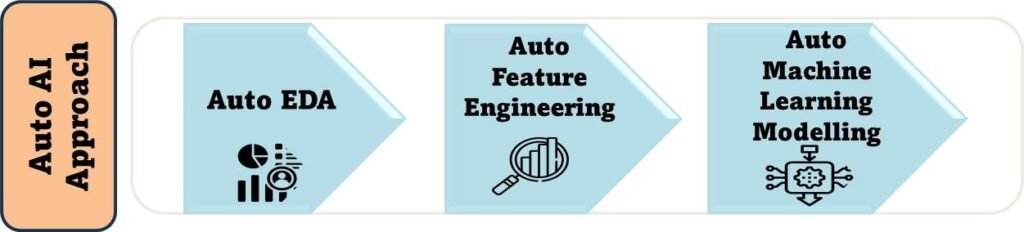
UnifyAI’s AutoAI feature revolutionizes the machine learning life cycle by automating many of the tedious and time-consuming tasks involved in the classical model development. AutoAI leverages AutoEDA, advanced AutoML techniques to automate feature engineering, model selection, and hyperparameter tuning, significantly reducing the time and effort required to build and deploy machine learning models. By automating these tasks, UnifyAI empowers data scientists to focus on more high-level tasks such as problem formulation, model interpretation, and business impact analysis, accelerating the overall development life cycle.
UnifyAI GenAI Capabilities
Integration with LLM’s for Enhanced Development:
In addition to its AutoAI capabilities, UnifyAI offers seamless integration LLM within UnifyAI that further enhances the development process. UnfiyAI’s SsaGPT(self Service Analytis GPT) enables data scientists to interactively explore and analyze data, extract insights, and generate reports using natural language queries. This empowers users to quickly gain insights from their data more efficiently. Furthermore, LLM’s integration in UnifyAI AutoAI allows data scientists to leverage UnfiyAIGPT capability to customize and optimize machine learning models using natural language prompts, enabling more intuitive and human-like interactions with the AI/ML development process.
Conclusion:
In summary, UnifyAI is revolutionizing the machine learning life cycle by accelerating the development process from end to end. With its innovative features and capabilities, UnifyAI is enabling organizations to scale their AI initiatives with speed, efficiency, and confidence, ultimately driving innovation and unlocking new opportunities in the ever-changing world of artificial intelligence.
Authored by Pritesh Tiwari, Founder & Chief Data Scientist of Data Science Wizards(DSW), this article defines how UnifyAI – the flagship platform of DSW is changing the game of AI adoption in enterprises by accelerating the AI/ML development lifecycle.
About Data Science Wizards (DSW)
Data Science Wizards (DSW) is a pioneering AI innovation company that is revolutionizing industries with its cutting-edge UnifyAI platform. Our mission is to empower enterprises by enabling them to build their AI-powered value chain use cases and seamlessly transition from experimentation to production with trust and scale.
To learn more about DSW and our ground-breaking UnifyAI platform, visit our website at darkseagreen-chicken-141904.hostingersite.com/. Join us in shaping the future of AI and transforming industries through innovation, reliability, and scalability.
The fusion of Artificial Intelligence (AI) and open source is rapidly becoming a cornerstone of enterprise innovation. As we navigate the next 18 to 22 months, this synergy is poised to redefine how businesses adopt AI in their daily operations and business value chain use cases. The role of AI platforms is becoming increasingly pivotal, especially those aligned with open architecture, in providing enterprises with the agility, scalability, and confidence to deploy AI solutions effectively.
The Power of Open Source in AI Innovations
Open source is the driving force behind AI’s democratization, offering accessibility, community-driven enhancements, and cost-effectiveness. It accelerates AI adoption by providing a collaborative environment where ideas and solutions are shared freely, leading to more robust and innovative AI models. Enterprises are leveraging open-source AI tools for various applications, from predictive analytics to customer experience enhancement, making AI more inclusive and diverse in its applications.
Changing Enterprise Landscape with AI and Open Source
The enterprise landscape is undergoing a profound transformation, thanks to the convergence of AI and open source. Companies are no longer restricted by proprietary systems and can now access cutting-edge AI technologies without significant investment. This shift is enabling businesses of all sizes to experiment with AI, leading to a more competitive and innovative market.
The Need for AI Platforms in Enterprise
As businesses embrace AI, the need for a comprehensive AI platform becomes evident. Enterprises require a system that not only facilitates the development and deployment of AI models but also ensures their effective orchestration in production environments. An ideal AI platform should offer:
Scalability to handle varying workloads
Flexibility to integrate with existing systems and data sources
User-friendly interface for seamless operation
Robust security and compliance mechanisms
Capability to leverage open-source tools and frameworks
Open Architecture: A Key Component
Open architecture in AI platforms plays a vital role in future-proofing enterprise AI initiatives. It offers flexibility and adaptability, ensuring that businesses can quickly respond to changing market dynamics and technological advancements. By embracing open architecture, AI platforms can easily integrate with a wide range of tools and technologies, fostering innovation and efficiency.
The Road Ahead: AI and Open Source in Enterprises
In the coming years, the combination of AI and open source is set to revolutionize enterprise operations. We will witness more enterprises adopting AI to automate processes, gain insights from data, and enhance customer experiences. Open source will continue to be a catalyst for this change, making AI more accessible and effective.
UnifyAI: Accelerating Enterprise AI Adoption by ~80%
UnifyAI, a product of Data Science Wizards, is a prime example of an AI platform that embodies these principles. It offers:
A user-friendly interface for building and deploying AI/ML use cases
Open architecture ensuring seamless integration with a range of open-source tools
Scalability and reliability for enterprise-grade applications
UnifyAI is not just a platform; it’s a bridge that connects enterprises to the future of AI, enabling them to harness the power of AI and open source effectively.
Conclusion:
As we look forward to the next 18 to 22 months, the synergy between AI and open source will undoubtedly be a game-changer in the enterprise world. Platforms like UnifyAI will be at the forefront, guiding businesses through their AI adoption journey, making the process more efficient, scalable, and aligned with future trends.
Authored by Sandeep Khuperkar, the CEO and Founder of Data Science Wizards (DSW), this article is a testament to our forward-thinking ethos and a commitment to pioneering the integration of AI within the enterprise arena. As we stand at the threshold of an AI-augmented future, DSW remains dedicated to leading the charge in innovation and transformative solutions.
About Data Science Wizards (DSW)
Data Science Wizards (DSW) is a pioneering AI innovation company that is revolutionizing industries with its cutting-edge UnifyAI platform. Our mission is to empower enterprises by enabling them to build their AI-powered value chain use cases and seamlessly transition from experimentation to production with trust and scale.
To learn more about DSW and our ground-breaking UnifyAI platform, visit our website at darkseagreen-chicken-141904.hostingersite.com/. Join us in shaping the future of AI and transforming industries through innovation, reliability, and scalability.
#UnifyAIForAll 💡 – Artificial Intelligence is helping businesses adapt at speed, with a regular stream of insights to drive innovation and competitive advantage in a world of constant disruption.
In this video, you will dive into the below details to gain a deeper understanding of how UnifyAI is accelerating the AI Adoption with predictability and scalability
➡ Roadmap for AI and Data Science adoption
➡ Challenges for enterprises during adoption of AI platform
➡ Benefits of implementing an AI platform in banking, insurance and retail industries
➡ Essential tips for aspiring AI and Data Science professionals
➡ What does the future for AI and UnifyAI platform look like
If you want to empower organizations of any size to #scale, #streamline, and #deploy AI projects seamlessly, integrating DataOps and MLOps and taking them to production, connect with us today for the demo.
About Data Science Wizards (DSW)
Data Science Wizards (DSW) is a pioneering AI innovation company that is revolutionizing industries with its cutting-edge UnifyAI platform. Our mission is to empower enterprises by enabling them to build their AI-powered value chain use cases and seamlessly transition from experimentation to production with trust and scale.
To learn more about DSW and our ground-breaking UnifyAI platform, visit our website at darkseagreen-chicken-141904.hostingersite.com/. Join us in shaping the future of AI and transforming industries through innovation, reliability, and scalability.
Deep Dive into UnifyAI’s Recipe for Rapid AI/ML Use Case Development from Experimentation to Production with Scale
Envision your enterprise’s AI journey as seamless as a master chef creating a culinary masterpiece. This is the essence of UnifyAI, which simplifies the progression from AI experimentation to production, much like crafting and serving a gourmet meal.
Gathering Ingredients (Data Integration): UnifyAI acts like a chef carefully selecting diverse ingredients. It blends various data sources seamlessly, forming a robust foundation for custom AI/ML use cases tailored to your unique business needs.
Crafting the Dish (Model Building): UnifyAI empowers you to build custom AI/ML models, similar to a chef experimenting with unique flavours, ensuring your solutions are precisely suited to your business’s taste.
Refining the Flavors (Model Refinement): Just as a chef fine-tunes a dish, UnifyAI provides tools to refine your models for peak effectiveness, striking the perfect balance for your business’s AI ambitions.
Scaling Up (Scalability and Adaptability): Mirroring a chef’s ability to cater to both intimate and large-scale events, UnifyAI scales your AI/ML models to keep pace with your evolving business needs, maintaining top-notch efficiency.
Presentation (Deployment and Integration): As a chef elegantly plates a meal, UnifyAI ensures the smooth integration and deployment of AI/ML models into your business environment, ensuring optimal functionality and alignment.
Continual Improvement (Maintenance and Monitoring): Similar to a chef preparing for the next service, UnifyAI consistently optimizes your models, keeping them ready for future challenges and opportunities.
Cost Efficiency (Reducing TCO): UnifyAI significantly cuts the total cost of ownership and accelerates AI/ML use case development from months to mere weeks, enhancing your enterprise’s profitability and operational efficiency.
Flexibility and Independence (No Vendor Lock-In): Promoting flexible, vendor-agnostic AI strategies, UnifyAI enables enterprises to develop AI/ML use cases that fit their specific needs, fostering innovation and customization.
AutoAI Capabilities in UnifyAI: Accelerating the AI/ML Journey
Streamlining the Process: AutoAI in UnifyAI is akin to having an expert assistant in the kitchen who preps ingredients, ensuring that everything is ready for the chef’s master touch. This functionality streamlines the initial phases of AI/ML projects, reducing the time and effort required in data preparation, feature selection, and initial model building.
Enhancing Flexibility and Efficiency: Just as a sous-chef adapts to the chef’s style and requirements, AutoAI offers the flexibility to align with diverse business needs. It allows for hyper-configurations, enabling businesses to tailor their AI/ML models to specific criteria and objectives. This level of customization ensures that models are not only built rapidly but also fine-tuned for optimal performance in real-world applications.
Fostering Hyper-Personalization: In the culinary world, understanding individual tastes is key to creating delightful dishes. Similarly, AutoAI facilitates hyper-personalization in model development. It helps in adjusting models to suit unique business contexts, ensuring that the outcomes are closely aligned with specific operational goals and customer expectations.
Enabling Hyperparameter Tuning: Refining a dish to perfection requires adjusting flavours and techniques; likewise, hyperparameter tuning is crucial in AI/ML models for peak performance. AutoAI provides tools and insights for effective hyperparameter tuning, ensuring that each model not only performs well under test conditions but also excels in live business environments.
Leveraging GenAI Capabilities:
Self-Service Analytics for Business Users:Imagine walking into a restaurant where, instead of a fixed menu, you’re presented with an interactive screen. Here, you can select ingredients, cooking styles, and flavours to create a dish tailored to your taste. This is akin to the Self Service Analytics in UnifyAI, which empowers business users to interact directly with AI tools.One can input their data, select parameters, and receive insights without needing deep technical knowledge. Just like customizing a meal to your preference, business users can tailor analytics to their specific business questions, getting real-time, actionable insights.
Prompt Engineering for Data Scientists: The Master Chef’s Secret Ingredients:In the heart of our kitchen, there’s a special cabinet filled with exotic spices, rare ingredients, and secret recipes, accessible only to the master chef. This is similar to prompt engineering in GenAI, a toolset exclusive to data scientists. It allows them to fine-tune AI models with advanced prompts, much like a chef uses special ingredients to elevate a dish.These prompts can adjust models for specific nuances and complexities of different business scenarios, enhancing the model’s relevance and accuracy. It’s like having a secret spice mix that turns a good dish into an unforgettable one.
Enhancing the AI Lifecycle: Orchestrating the Culinary Symphony: Integrating GenAI capabilities into UnifyAI is like adding a new layer of sophistication to our restaurant’s operations. It enhances the entire process from data integration (sourcing ingredients) to model deployment (serving the dish). With Self Service Analytics, business users are no longer just spectators; they are actively involved in creating their analytical dishes. Meanwhile, prompt engineering equips data scientists with advanced tools, much like giving a master chef access to a broader range of gourmet ingredients.
UnifyAI is more than a platform; it’s an integral part of your enterprise’s AI strategy. It aids every step of the AI/ML journey, from data integration to model deployment, and orchestrating your AI/ML use cases in production with scale and confidence. UnifyAI empowers your enterprise to innovate, refine, and deliver exceptional AI experiences efficiently and creatively.
Embrace the innovative blend of classical AI and GenAI with UnifyAI, and take your enterprise’s AI journey to new heights of success and creativity.
Authored by Sandeep Khuperkar, the CEO and Founder of Data Science Wizards (DSW), this article is a testament to our forward-thinking ethos and a commitment to pioneering the integration of AI within the enterprise arena. As we stand at the threshold of an AI-augmented future, DSW remains dedicated to leading the charge in innovation and transformative solutions.
About Data Science Wizards (DSW)
Data Science Wizards (DSW) is a pioneering AI innovation company that is revolutionizing industries with its cutting-edge UnifyAI platform. Our mission is to empower enterprises by enabling them to build their AI-powered value chain use cases and seamlessly transition from experimentation to production with trust and scale.
To learn more about DSW and our ground-breaking UnifyAI platform, visit our website at darkseagreen-chicken-141904.hostingersite.com/. Join us in shaping the future of AI and transforming industries through innovation, reliability, and scalability.
#UnifyAI #EnterpriseAI #AIJourney #DataIntegration #ModelBuilding #AIAdoption #BusinessInnovation #TechnologyLeadership #ArtificialIntelligence #MachineLearning #GenAI #SelfServiceAnalytics #PromptEngineering #DataScience #AIInnovation #BusinessIntelligence #CulinaryAnalogy #TechInnovationTop of Form
In today’s rapidly transforming enterprise environment, artificial intelligence (AI) has evolved from an intriguing novelty to an essential component of business strategy. As AI increasingly integrates into the core business value chain, its potential to revolutionize various aspects of enterprise operations is being recognized and actively utilized. AI is not just a tool for automating routine tasks and enhancing analytics; it’s a game-changer in customer engagement, operational optimization, and driving innovation across company operations.
The forthcoming 18 months are poised to witness an increasingly significant shift in almost every organization from experimental AI applications to robust, operational implementations. This transition marks the democratization of AI, propelled by AI as native platforms and AI as a Service (AIaaS) platforms, which will reduce entry barriers for businesses of all sizes and usher in a new era of innovation and accessibility. The emergence of explainable AI (XAI) is set to introduce much-needed transparency into AI decision-making processes, a critical development, especially in regulated industries such as banking, insurance, and retail. In these strategic sectors, AI is anticipated to bring transformative changes in service delivery, risk assessment, and supply chain management.
As we look to the future, the role of AI within the enterprise sector is poised to be transformative. Embracing this technology is key to driving innovation and maintaining a competitive edge. Organizations are seeking platforms that can not only reduce the time to market but also allow for rapid innovation. UnifyAI is poised to meet these needs, providing the capabilities necessary for enterprises to confidently transition their AI use cases from concept to production.
However, the journey of integrating AI within businesses is complex and challenging. These challenges include the intricacies of merging diverse technological aspects required by AI, ethical considerations, potential biases in AI systems, a growing gap in AI talent, privacy concerns, and the hurdles in merging AI with existing legacy systems. Overcoming these challenges necessitates robust governance, a culture of continuous learning, and strategic infrastructure investments.
In this intricate ecosystem, there’s a rising demand for a comprehensive AI platform that can guide enterprises smoothly from AI experimentation to full-scale production. Enter UnifyAI, an intuitive, end-to-end platform designed to facilitate the seamless adoption of AI in businesses. UnifyAI transcends being a mere collection of services; it’s a comprehensive solution addressing the entire AI deployment cycle. This includes the integration of varied data sources, feature engineering, managing feature stores, developing & deploying models effortlessly with single click, maintaining model repositories, and effective monitoring and management of these models.
Today, most organizations are doing experimentation or POC, on building AI/ML use cases and trying to figure out the best way possible to go into production with predictability and scale, and for that, they are surely looking at a structured way of CI/CD framework for all their AI initiatives. One of the important things we need to understand is that adopting AI by enterprises is to enhance their business and operational efficiency and also to innovate the products in a way and go to market leveraging their own huge data and external factors, and that is where AI helps organizations to innovate and deliver the best based on data inferences. Adopting AI is in no way going to change a tyre manufacturing company into a car manufacturing company, but it will for sure enhance the way they will work in their own business to bring out the best in data insights and convert them into actionables.
One analogy I would like to share here is that when, in the initial days, maybe 10–12 years ago, organizations were exploring the container concept to package their applications, the goal at that point in time was to containerize the application and roll it out in multiple locations without errors of deployment. But as more and more applications were containerized, they started looking at a different challenge, which is managing, monitoring, and orchestrating the containers and having high availability and communication through mesh among containers, and that is where we started seeing a steep upward momentum in container orchestration platforms like Kubernetes.
Likewise, today most organizations are developing models in POC and trying to pilot their use cases, but in coming times when they will have multiple ML models running, multiple data pipelines, and more than 3–4 use cases to take to production and manage and scale in production, they will surely need a platform that will provide them with capabilities like CI/CD and orchestrate their use cases end-to-end in production, where ML models will be critical but a small part. This is where UnifyAI is helping organizations today to build use cases and take them to production, and tomorrow it will help organizations grow and scale with multiple use cases and enable them to orchestrate use cases.
What sets UnifyAI apart is its highly customizable and configurable capability, allowing every enterprise to tailor their AI journey as per their unique needs, thus providing the flexibility to innovate as per their specific requirements. The platform offers seamless integration of existing and new models, enabling a rapid transition from concept to pilot to production. Its operationalization, feature store, and orchestration capabilities enable reusability, scalability, governance, and growth, addressing many of the challenges enterprises face in adopting AI.
AI and the Enterprise: The Path Forward
As we embrace a future interwoven with AI, the enterprise landscape stands on the cusp of a new dawn. The next phase is not merely about AI integration but about reimagining the very fabric of business operations through intelligent innovation. UnifyAI stands ready as a beacon, guiding enterprises through this transformative journey with a platform that not only navigates the present complexities but also pioneers the advancements of tomorrow. It promises a future where AI empowers every facet of the enterprise, fostering a synergy between human creativity and machine intelligence for unparalleled growth and success.
Authored by Sandeep Khuperkar, the CEO and Founder of Data Science Wizards (DSW), this article is a testament to our forward-thinking ethos and a commitment to pioneering the integration of AI within the enterprise arena. As we stand at the threshold of an AI-augmented future, DSW remains dedicated to leading the charge in innovation and transformative solutions.
About Data Science Wizards (DSW)
Data Science Wizards (DSW) is a pioneering AI innovation company that is revolutionizing industries with its cutting-edge UnifyAI platform. Our mission is to empower enterprises by enabling them to build their AI-powered value chain use cases and seamlessly transition from experimentation to production with trust and scale.
To learn more about DSW and our ground-breaking UnifyAI platform, visit our website at darkseagreen-chicken-141904.hostingersite.com/. Join us in shaping the future of AI and transforming industries through innovation, reliability, and scalability.
In our last articles, we discussed a detailed introduction to the time series data and covered some technical methods and approaches to process time series data. We also discussed that time series data is different from any general tabular or other kind of data as it holds tabular information in a sequential format. While performing analysis on such data it is important to process this data to get accurate results out of it. There are multiple steps required to complete time series processing and decomposing time series is one of them that helps us analyse and understand a time series more deeply. In this article, we are going to take this course on time series processing to the next step where we will be discussing the time series decomposition using the following points.
Table of Content
What is Time Series Decomposition?
The Reasons Behind Time Series Decomposition
Methods of Time Series Decomposition
Additive decomposition
Multiplicative decomposition
Seasonal-Trend Decomposition using LOESS (STL)
What is Time Series Decomposition?
Trend: This represents the long-term direction or pattern in the data, indicating whether it’s increasing, decreasing, or stable over time.
Seasonality: This component reflects regular, repeating patterns within the data. For instance, sales of winter coats tend to rise in colder months and fall in warmer ones.
Cyclic: The cyclic component represents fluctuations in the data that occur over a more extended period than seasonality but are not strictly periodic. Unlike seasonality, cyclical patterns don’t necessarily repeat at fixed intervals. An example of a cyclic pattern is the economic business cycle between 5 to 7 years.
Noise (or Residuals): This is the random variation or irregularity that remains after removing the trend and seasonal components.
By decomposing a time series, you gain a clearer understanding of the underlying patterns and trends, making it easier to analyze and forecast the data accurately. This process helps in isolating and understanding the distinct features of the time series, which can be valuable for various analytical and forecasting tasks.
The Reasons Behind Time Series Decomposition
When we dive into any time series analysis project, understanding the changes in the data with time becomes a crucial aspect to understand, and when we decompose a time series we get to know critical information such as changes with time in time series, its seasonal and cyclic behaviour and many more about that time series and can be utilized further in the next step in time series analysis. Here are some major reasons behind time series decomposition.
Pattern Identification: Time series decomposition helps identify and separate different patterns within the data, such as trends, seasonality, and cyclical variations. Recognizing these patterns is crucial for understanding the inherent structure of the time series.
Model Simplicity: Decomposing a time series simplifies the modelling process by breaking down the complex data into more manageable components. Simpler models are easier to interpret and can provide clearer insights into the behaviour of the time series.
Anomaly Detection: Examining the residuals (the part of the time series not explained by trends, seasonality, or cycles) helps identify anomalies or irregularities. Detecting anomalies is crucial for understanding unexpected events and outliers that may impact the analysis.
Understanding Component Contributions: Decomposition provides a clear breakdown of how each component contributes to the overall behaviour of the time series. This understanding is valuable for attributing changes in the data to specific factors, aiding in decision-making.
Decomposition of any time series data not only helps in understanding time series but also enhances the efficiency of in-lined processes in time series analysis. Let’s take a look at how decomposing a time series helps further in any project.
Further Applications in Time Series Analysis
Enhanced Modeling: The decomposed components can be used to build more sophisticated models, such as additive or multiplicative models, which incorporate the identified patterns for improved accuracy. Enhanced modelling leads to a better representation of the time series dynamics.
Strategic Planning: Understanding trends and cyclical variations aids in strategic planning for businesses, helping them align their strategies with anticipated changes in the market. This leads to Improved strategic decisions based on a comprehensive understanding of the time series components.
Optimized Resource Allocation: Forecasting based on decomposed components facilitates optimized resource allocation, helping organizations allocate resources efficiently based on anticipated demand. Efficient resource allocation leads to cost savings and improved operational effectiveness.
Performance Monitoring: Monitoring residuals over time allows for ongoing performance assessment, helping to identify deviations from expected patterns.Early detection of performance issues and the ability to adjust strategies in response to changing trends.
Here are the few major reasons and applications behind a time series decomposition process, after knowing the reasons, we are required to understand how we can perform time series decomposition in real life. Let’s understand them using examples.
Methods of Time Series Decomposition
There are multiple ways to decompose a time series and here we are going to discuss the following most used ways to decompose the time series:
Additive Decomposition
Multiplicative Decomposition
Seasonal-Trend Decomposition using LOESS (STL)
Additive Decomposition
This method of decomposing a time series considers that the components of the time series are additive, meaning that the observed time series data can be expressed as the sum of its components (trend, cycle, seasonality, and noise), as given below expression:
Y(t) =T(t) + S(t) + ε(t)
Where:
Y(t) = Observed time series data at time t
T(t) = Trend component at time t
S(t) = Seasonal component at time t
ε(t) = Residuals (or error) at time t
Additive decomposition is particularly suitable for time series data where the magnitude of the seasonal fluctuations remains relatively constant over time, regardless of the level of the series. This type of decomposition can be performed using the following way:
Simple Moving Averages (SMA): This technique involves calculating the average of a fixed-size window of data points to smooth out short-term fluctuations.
Exponential Smoothing: Specifically, single exponential smoothing for data with no clear trend or seasonality, and Holt-Winters method for data with both trend and seasonality.
Data Generation
Before performing additive decomposition let’s make a dummy data so that we can go further in the process.
import pandas as pd
import numpy as np
import matplotlib.pyplot as plt
from statsmodels.tsa.holtwinters import SimpleExpSmoothing
# Generate a dummy time series with trend, seasonality, and residual
Here we got to learn how we can use different methods for decomposing a time series using the additive methods. Now let’s understand and explore how we can use the multiplicative methods of decomposing the time series.
Multiplicative Methods
As the name suggests, components in multiplicative decomposition are considered to be multiplicative, meaning that the observed time series data can be expressed as the product of its components(trend, cycle, seasonality, and noise) as given in the below expression:
Y(t) =T(t) S(t) ε(t)
Where:
Y(t) = Observed time series data at time t
T(t)= Trend component at time t
S(t) = Seasonal component at time t
ε(t) = Residuals (or error) at time t
Usually, this decomposition is suitable for time series data where the magnitude of the seasonal fluctuations varies in proportion to the level of the series. Let’s see how we can perform this type of decomposition using Python and statsmodels provided module:
from statsmodels.tsa.seasonal import seasonal_decompose
# Perform multiplicative decomposition
result = seasonal_decompose(ts, model=‘multiplicative’)
Here we can see that the results for decomposition of the same time series are different from the additive decomposition because multiplicative decomposition considers the sequential data as the product of trend, seasonality and residual components. Let’s take a look at our next method to decompose a time series method.
Seasonal-Trend Decomposition using LOESS (STL)
In addition to additive and multiplicative decomposition, another powerful method for decomposing time series data is Seasonal-Trend decomposition using LOESS (STL). we can use this method when we find the time series has complex seasonal patterns.
It works similarly to the other decomposition method but employing LOESS(locally estimated scatterplot smoothing) makes it different from the other methods. We can compare LOESS with the non-parametric regression technique we can use for smoothing data. It’s particularly useful for capturing local trends or patterns in noisy datasets.
This method can make us handle datasets with intricate seasonal variations. This method is particularly valuable in scenarios where other decomposition techniques may struggle to capture complex seasonal patterns effectively.
Let’s take a look at how we can perform this type of time series decomposition.
Here we can see how this method worked to decompose the time series into its components.
Final words:
In this article, we’ve explored another crucial time series preprocessing technique. This method not only enhances the clarity of time series data but also lays the foundation for various types of forecasting, including trend and seasonal forecasting. Integrating these forecasts often leads to more accurate predictions. By dissecting a time series into its individual components, we gain a profound understanding of its underlying patterns before proceeding with further modelling. This approach serves as a crucial step in the time series analytical process.